Standard time: 1h 45mWith approved 25% extra time: 2h 11m 15s · 80 marks
Independent Exam Stash practice paper. All questions, tasks and indicative teacher guidance are original. This is not an official AQA or Eduqas paper and is not endorsed by either board.
This 80-mark practice set uses only original printed lines 32–74 of the linked Eduqas June 2024 fiction source (approximately 630 words). The questions follow the AQA Paper 1 skills, mark allocations and 2026 question approach. The original Eduqas questions, timings and instructions do not apply. This paper has not been trialled or standardised by an awarding body; do not use official grade boundaries to assign it a GCSE grade.
Source A: Alice and Jack on the farm — Eduqas June 2024 fiction selection
Official Eduqas C700U10-1A resource booklet, PDF pages 2–3, ORIGINAL PRINTED LINES 32–74 ONLY. Line numbers refer to the printed text, not PDF line extraction.
Downloaded from WJEC’s freely accessible public past-paper service and verified 15 November 2026. The cover classifies the source as 20th-century literature. No author or original literary title is stated in the source booklet; none is invented here. The adapted passage and board layout remain external and are not reproduced in this resource.
Reading instructions
Time allowed: 1 hour 45 minutes. Total: 80 marks.
For approved 25% extra time, the corresponding practice allowance is 2 hours 11 minutes 15 seconds. Use the access arrangements agreed for the pupil.
You need the linked Eduqas source booklet open beside this question paper and the answer booklet or separate paper for your answers.
Source A for this paper is ONLY the section from original printed line 32 to original printed line 74, inclusive. Read this selection carefully before answering. Do not read lines 75–83 for this practice task.
Keep the original printed line numbers: do not renumber the selection from 1. The first selected line is printed line 32, beginning with the passing of time; the last selected line is printed line 74, ending with the youngest Paget son’s aptitude for farming.
Context: Alice lives on a farm in Australia with her father, Jack. His sister had argued that Alice should grow up in town, but Alice stayed with him.
Answer all questions in Section A and ONE of the two writing tasks in Question 5.
Suggested allocation: about 15 minutes reading, then about 45 minutes answering Section A and 45 minutes on Section B. These are planning suggestions, not separate timed sections.
For Question 1, shade one circle inside a box for each item. If you change your answer, cross out the whole box clearly and shade the new choice.
Read the first part of the selected Source A, original printed lines 32–38. Answer all four questions below. Shade one circle inside a box for each question. Each correct answer is worth 1 mark.
1(a) How did Jack’s sister respond to his success in raising Alice?
A. She praised him frequently and enthusiastically.
B. She was privately disappointed and praised him reluctantly.
C. She refused to meet him again.
1(b) Where did Jack take Alice each morning?
A. To visit her aunt.
B. To work in the fields.
C. To school in town.
1(c) What does the passage tell us about collecting Alice after school?
A. Jack always arrived on time.
B. Jack usually sent another farmer.
C. Jack often forgot when work was busy.
1(d) Who chose the clothes Jack bought for Alice?
A. Jack’s sister.
B. Alice herself.
C. Alice’s teacher.
Question 2 · 8 marks
Look in detail at original printed lines 46–55. How does the writer use language to show Alice’s response to the possibility of art school? Support your analysis with short references to this part of the source. You could consider particular words and phrases, language features, and sentence forms.
Question 3 · 8 marks
You now need to think about the whole of OUR selected source: original printed lines 32–74. How has the writer structured this selection to create tension about Alice’s future? You could consider what is established at the beginning, how the focus or pace changes, and the effect of the ending.
Question 4 · 20 marks
Focus this part of your answer on the later part of OUR selected source, original printed lines 59–74. “Jack’s answer appears to give Alice freedom, but the writing shows how difficult it will be for her to use that freedom.” To what extent do you agree and/or disagree? Evaluate the impressions the writer creates, comment on the methods used, and support your judgement with references to this part of the source.
Question 5 · 40 marks
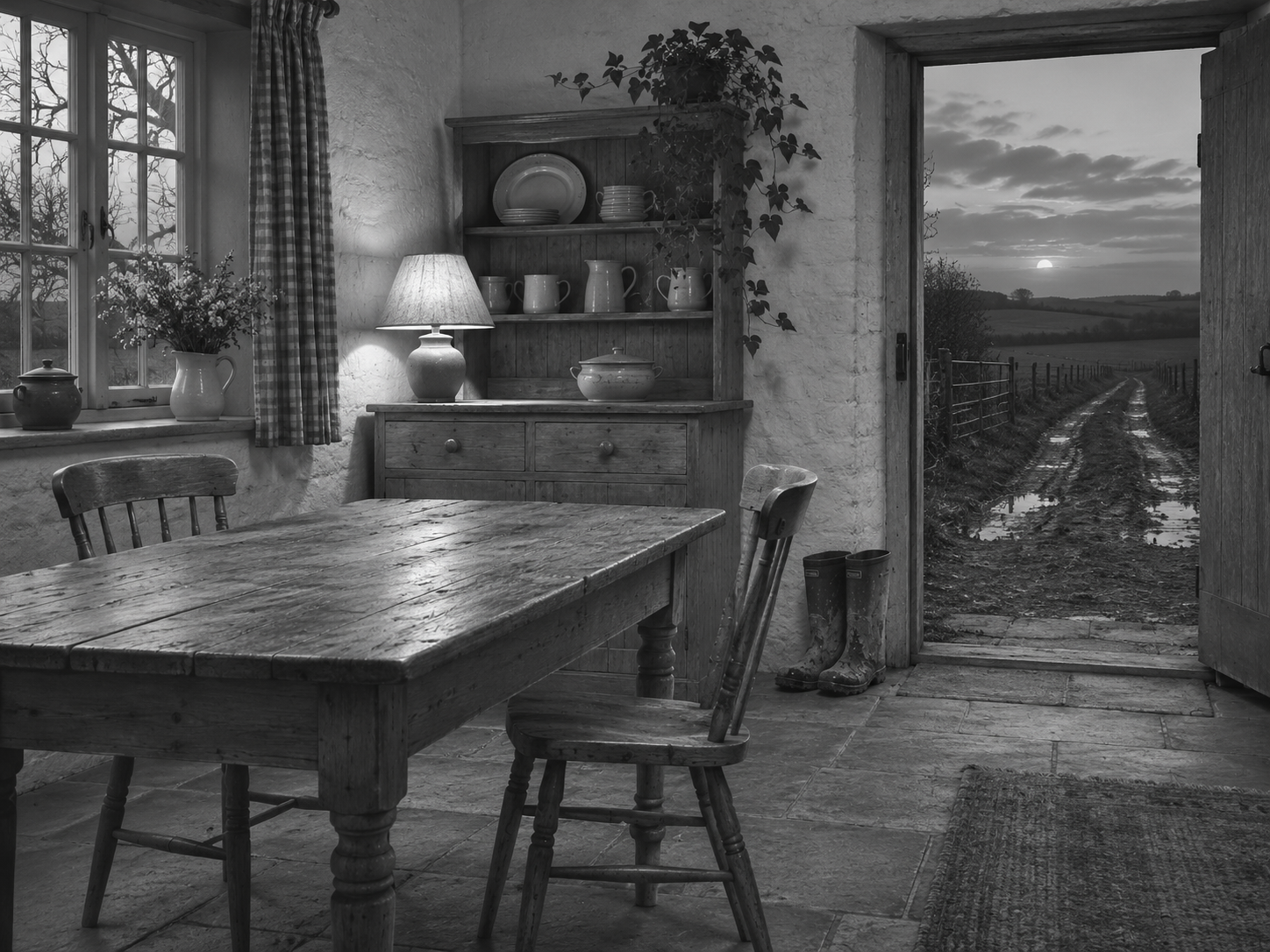
Section B: Writing. You are advised to spend about 45 minutes on this question, including planning and checking. Choose ONE task. EITHER write a description of a place where somebody is about to make an important decision, using the picture as a starting point. You may use your imagination: you do not have to describe the exact scene in the picture. OR write the opening of a story in which somebody is offered an unexpected opportunity. You do not need to write a complete story. (24 marks for content and organisation; 16 marks for technical accuracy.)
Original Exam Stash writing stimulus.Teacher guidance and indicative marking
These are original indicative marking notes, not an official AQA mark scheme or a standardised assessment. Credit valid alternative interpretations supported by the specified selection.
Read the whole response, select the best-fitting band, then decide the mark within that band. A strong performance in one bullet does not automatically determine the whole answer. Award 0 for nothing relevant.
Questions 1–4 total 40 marks; Question 5 totals 40 marks, split AO5 24 and AO6 16. No grade conversion is provided.
The 2026 approach includes four 1-mark multiple-choice items for Question 1, a single structural effect in Question 3, a defined extract range and agreement and/or disagreement in Question 4, and an imaginative picture description or narrative opening in Question 5.
For the first reading of the selected passage, the teacher may give the original contextual sentence printed above. The source itself remains in its publisher’s PDF; the learner needs it alongside this paper.
Question 1 · 4 marks · AO1
Correct answers: 1(a) B; 1(b) C; 1(c) A; 1(d) B. Award one mark per correct selection. No mark for an item with multiple uncancelled selections.
All answers come from original printed lines 32–38. They assess straightforward comprehension, not interpretation of later events.
Question 2 · 8 marks · AO2
Explore the interplay of possibility, excitement, financial doubt and difficulty speaking about the future. Relevant evidence is at lines 48–50 (successive possibilities and her immediate response), lines 50–52 (money and her reaction to praise), and lines 53–55 (questions followed by her physical response and the short statements of silence).
Explain how the language creates these impressions. Do not give marks for identifying a technique without explaining its effect in context. Strong responses may explore whether the excitement is being restrained by practical concern, uncertainty, or both.
Credit accurate alternative readings supported from the specified lines. Use the four 2-mark AO2 bands and best fit; do not expect a fixed list of devices or number of quotations.
0 marks
Nothing relevant to the question.
1–2 marks
Simple, relevant comment with a reference or example; effects may be asserted rather than explained.
3–4 marks
Some explanation of relevant choices and effects, supported by appropriate examples.
5–6 marks
Clear, developed explanation of how the writing achieves the specified effect, using well-selected references.
7–8 marks
Perceptive, detailed analysis of choices and their effects, supported by precise, judicious references.
Question 3 · 8 marks · AO2
At lines 32–45 the account moves quickly through years of apparently successful family life, largely from Jack’s perspective. This establishes an arrangement that seems secure.
Lines 46–58 introduce art school and shift towards Alice’s hopes and the teacher’s judgement. The new possibility threatens the earlier stability.
At lines 59–68 the narrative slows to a meal and hesitant conversation: speech, pauses and reactions postpone a clear resolution.
Lines 69–74 move into Alice’s understanding of what her departure could mean and end on a possible farming successor. This leaves competing futures in play rather than resolving her decision.
Explain how sequencing, changes of focus, pace or viewpoint produce tension. Language analysis alone does not answer this structural question. Credit other well-supported structural interpretations. Apply the four 2-mark AO2 bands by best fit.
0 marks
Nothing relevant to the question.
1–2 marks
Simple, relevant comment with a reference or example; effects may be asserted rather than explained.
3–4 marks
Some explanation of relevant choices and effects, supported by appropriate examples.
5–6 marks
Clear, developed explanation of how the writing achieves the specified effect, using well-selected references.
7–8 marks
Perceptive, detailed analysis of choices and their effects, supported by precise, judicious references.
Question 4 · 20 marks · AO4
A response may agree, disagree or qualify the statement. There is no preferred position. A strong judgement weighs both what Jack says and what Alice perceives.
Lines 59–64: the domestic setting and hesitant exchange can suggest Alice’s existing role and difficulty introducing change. They do not prove that Jack has explicitly forbidden her to leave.
Lines 65–68: his physical reactions and troubled behaviour may complicate the apparent permission in his brief reply. Consider how the contrast between speech and behaviour shapes the reader’s judgement.
Lines 69–74: Alice imagines the consequences of leaving and an alternative involving a farming successor. The narrative is filtered through her understanding, so a nuanced response can distinguish her interpretation from a directly stated command by Jack.
Judge the evaluation across the answer, including how methods support the judgement. Use best fit across the four 5-mark AO4 bands. Credit supported alternatives and do not insist on agreement or on covering every idea here.
0 marks
Nothing relevant to the question.
1–5 marks
A simple judgement with limited textual support; little explanation of how the writing shapes the response.
6–10 marks
Some supported evaluation, with some explanation of relevant writing choices.
11–15 marks
Clear, sustained evaluation of the statement, with developed explanation of methods and well-selected references.
16–20 marks
Convincing, perceptive evaluation of the statement, with detailed consideration of methods and judicious evidence.
Question 5 · 40 marks · AO5:24 / AO6:16
Mark the chosen response independently of Section A. It need not retell the source or use its characters. Treat the two options as equally valid.
AO5 (24 marks): judge the effectiveness of communication for the chosen description or narrative opening; appropriateness and control of tone, viewpoint and vocabulary; development of selected details; and purposeful organisation. Do not require a complete plot for the narrative opening.
AO6 (16 marks): judge sentence control and variety, grammar, punctuation and spelling separately from AO5. Reward accuracy and deliberate variation, not a count of unusual words or techniques.
Use the original practice band summaries below as indicative guidance and moderate against the current official writing criteria. This guide has not been standardised by AQA.
AO5
0 marks
No relevant response.
1–6 marks
Simple communication with limited development or organisation.
7–12 marks
Some successful communication and development, with some organisation and appropriate choices.
13–18 marks
Clear, effective and developed communication, with controlled organisation and vocabulary.
19–24 marks
Compelling, convincing communication, developed detail and assured, purposeful organisation and language.
AO6
0 marks
No creditable technical control.
1–4 marks
Limited control of sentences, grammar, spelling and punctuation.
5–8 marks
Some secure control, with some sentence variety; errors remain evident.
9–12 marks
Generally accurate and controlled sentences, grammar, spelling and punctuation, with effective variety.
13–16 marks
Consistently secure, deliberate control of varied sentence structures, grammar, spelling and punctuation.
Assessment approach checked against AQA’s current guidance ↗. Text rights remain with the source rights holders. The original source PDFs remain on the publisher’s website.