The Sheridan family is preparing for a garden party. Laura has been asked to show the workmen where to put a large tent called a marquee.
1Four men in their shirt-sleeves stood grouped together on the garden path. They
2carried staves covered with rolls of canvas, and they had big tool-bags slung on
3their backs. They looked impressive. Laura wished now that she had not got the
4bread-and-butter, but there was nowhere to put it, and she couldn’t possibly
5throw it away. She blushed and tried to look severe and even a little bit
6short-sighted as she came up to them.
7“Good morning,” she said, copying her mother’s voice. But that sounded so
8fearfully affected that she was ashamed, and stammered like a little girl,
9“Oh—er—have you come—is it about the marquee?”
10“That’s right, miss,” said the tallest of the men, a lanky, freckled fellow, and
11he shifted his tool-bag, knocked back his straw hat and smiled down at her.
12“That’s about it.”
13His smile was so easy, so friendly that Laura recovered. What nice eyes he had,
14small, but such a dark blue! And now she looked at the others, they were smiling
15too. “Cheer up, we won’t bite,” their smile seemed to say. How very nice workmen
16were! And what a beautiful morning! She mustn’t mention the morning; she must be
17business-like. The marquee.
18“Well, what about the lily-lawn? Would that do?”
19And she pointed to the lily-lawn with the hand that didn’t hold the
20bread-and-butter. They turned, they stared in the direction. A little fat chap
21thrust out his under-lip, and the tall fellow frowned.
22“I don’t fancy it,” said he. “Not conspicuous enough. You see, with a thing like
23a marquee,” and he turned to Laura in his easy way, “you want to put it
24somewhere where it’ll give you a bang slap in the eye, if you follow me.”
25Laura’s upbringing made her wonder for a moment whether it was quite respectful
26of a workman to talk to her of bangs slap in the eye. But she did quite follow
27him.
28“A corner of the tennis-court,” she suggested. “But the band’s going to be in
29one corner.”
30“H’m, going to have a band, are you?” said another of the workmen. He was pale.
31He had a haggard look as his dark eyes scanned the tennis-court. What was he
32thinking?
33“Only a very small band,” said Laura gently. Perhaps he wouldn’t mind so much if
34the band was quite small. But the tall fellow interrupted.
35“Look here, miss, that’s the place. Against those trees. Over there. That’ll do
36fine.”
37Against the karakas. Then the karaka-trees would be hidden. And they were so
38lovely, with their broad, gleaming leaves, and their clusters of yellow fruit.
39They were like trees you imagined growing on a desert island, proud, solitary,
40lifting their leaves and fruits to the sun in a kind of silent splendour. Must
41they be hidden by a marquee?
42They must. Already the men had shouldered their staves and were making for the
43place. Only the tall fellow was left. He bent down, pinched a sprig of lavender,
44put his thumb and forefinger to his nose and snuffed up the smell. When Laura
45saw that gesture she forgot all about the karakas in her wonder at him caring
46for things like that—caring for the smell of lavender. How many men that she
47knew would have done such a thing? Oh, how extraordinarily nice workmen were,
48she thought. Why couldn’t she have workmen for her friends rather than the silly
49boys she danced with and who came to Sunday night supper? She would get on much
50better with men like these.
51It’s all the fault, she decided, as the tall fellow drew something on the back
52of an envelope, something that was to be looped up or left to hang, of these
53absurd class distinctions. Well, for her part, she didn’t feel them. Not a bit,
54not an atom.... And now there came the chock-chock of wooden hammers. Some one
55whistled, some one sang out, “Are you right there, matey?” “Matey!” The
56friendliness of it, the—the—Just to prove how happy she was, just to show the
57tall fellow how at home she felt, and how she despised stupid conventions, Laura
58took a big bite of her bread-and-butter as she stared at the little drawing. She
59felt just like a work-girl.
Question 01 [4 marks]
Read again the first part of the source, from lines 1 to 6.
Answer all parts of this question.
Choose one answer for each question.
Shade the circle inside the box beside your chosen answer.
Select no more than one answer for each question.
Cross out the whole box if you make a mistake.
To restore an answer you crossed out, draw a circle around that box.
01.1 How many workmen are standing on the path?
Two
Four
Six
01.2 What material is rolled around the staves they carry?
Paper
Leather
Canvas
01.3 What is Laura holding?
Bread-and-butter
A tool-bag
A straw hat
01.4 What happens to Laura as she approaches the men?
She begins to laugh.
She drops what she is carrying.
She blushes.
Question 02 [8 marks]
Look in detail at this extract, from lines 42 to 50 of the source:
They must. Already the men had shouldered their staves and were making for the
place. Only the tall fellow was left. He bent down, pinched a sprig of lavender,
put his thumb and forefinger to his nose and snuffed up the smell. When Laura
saw that gesture she forgot all about the karakas in her wonder at him caring
for things like that—caring for the smell of lavender. How many men that she
knew would have done such a thing? Oh, how extraordinarily nice workmen were,
she thought. Why couldn’t she have workmen for her friends rather than the silly
boys she danced with and who came to Sunday night supper? She would get on much
better with men like these.
How does the writer use language here to show Laura’s admiration for the workman?
You could include the writer’s choice of:
words and phrases
language features and techniques
sentence forms.
Question 03 [8 marks]
You now need to think about the structure of the source as a whole.
This text comes from near the beginning of a short story.
How has the writer structured the text to create a growing sense of ease for Laura?
You could write about:
how Laura’s sense of ease has changed by the end of the source
how the writer uses structure to create an effect
other structural choices, including changes in mood, tone or perspective.
Question 04 [20 marks]
For this question focus on the later part of the source, from line 42 to the end.
In this part of the source, Laura imagines becoming friends with the workmen. Her enthusiasm seems genuine, but her belief that she now understands their lives seems rather naïve.
To what extent do you agree and/or disagree with this statement?
In your response, you could:
consider your impressions of Laura’s response to the workmen
comment on the methods the writer uses to present Laura
support your response with references to the text.
Question 05 [40 marks]
A local magazine is inviting entries for a creative writing competition.
Choose one of the options below for your entry.
Either
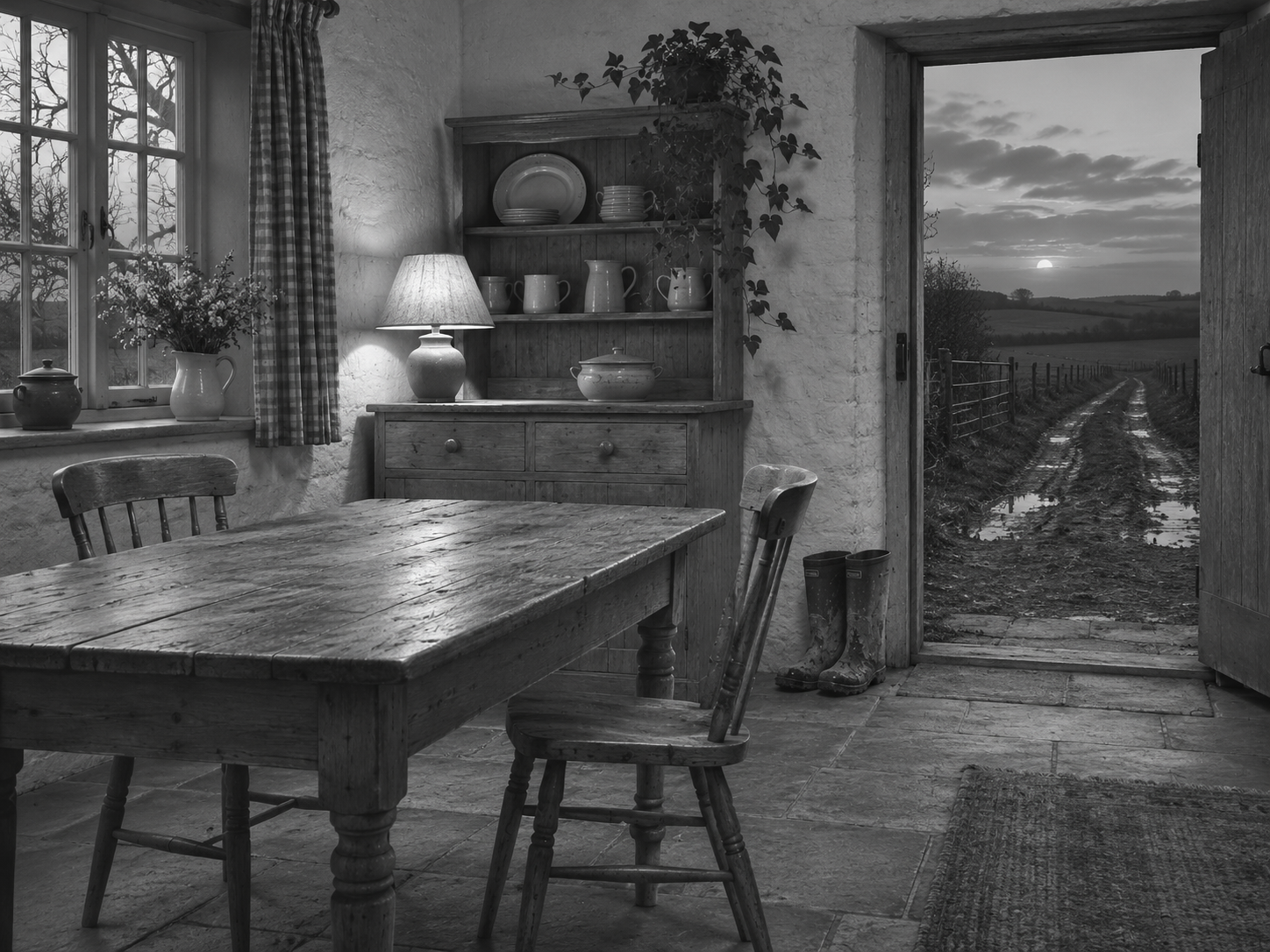
Write a description of a quiet room shortly before an important visitor arrives, from your imagination. You may choose to use the picture provided for ideas.
or
Write the opening of a story in which somebody returns after a long absence.
Marking guidance
Question 1
Correct answers: 01.1: Four; 01.2: Canvas; 01.3: Bread-and-butter; 01.4: She blushes.. Award one mark for each correct selection. If an item has more than one uncancelled selection, award no mark for that item.
All answers are explicit in lines 1–6.
Question 2
Lines 43–46: the closely observed sequence of gestures gives the man’s enjoyment of lavender an unhurried, attentive quality. Laura’s response is immediate and changes the focus of her thoughts. Explain the effects of the selection and emphasis.
Lines 46–48: repeated reference to caring, the rhetorical question and the exclamatory judgement can convey surprise and growing enthusiasm. Her thoughts are brought close to the reader rather than reported at a distance.
Lines 48–50: the contrast between the workmen and the boys she normally meets can idealise the new acquaintance. Strong answers may explore the extent to which admiration exceeds what she can actually know about him.
Use the four 2-mark AO2 bands by best fit. Reward precise explanation of language effects rather than naming devices alone. Credit other supported readings from these lines.
Question 3
Lines 1–9 begin with an awkward approach and an unsuccessful attempt to sound adult. This establishes the discomfort that will change.
Lines 10–17 introduce a friendly response and move into Laura’s increasingly positive thoughts. The shift from outward performance towards her private reactions draws us closer to her changing experience.
Lines 18–41 develop a practical exchange, including disagreement and hesitation over where the marquee belongs. These interruptions keep the change from feeling wholly smooth.
Lines 42–50 narrow the focus to the workman’s small gesture and expand Laura’s enthusiasm into imagined friendship. Lines 51–59 then broaden into her thoughts about social conventions and end with a physical action that contrasts with her embarrassment about food at the beginning.
Explain the effects of sequence, shifts of focus, pace or viewpoint in relation to this one effect. Word-level analysis alone does not answer the structural question. Use the four 2-mark AO2 bands by best fit and credit other supported interpretations.
Question 4
A response can agree, disagree or qualify the statement. There is no preferred position. A convincing answer distinguishes the sincerity of Laura’s feeling from what she can reasonably know after a brief encounter.
Lines 43–50: Laura notices appreciation of nature and imagines friendship. The close presentation of her questions and excited thoughts can make her warmth convincing while leaving room to question how quickly she generalises.
Lines 51–54: her confident rejection of social distinctions follows a short experience. The emphatic insistence can be read as conviction, self-persuasion or both; explain how the writing shapes that judgement.
Lines 54–59: sounds of shared work and the exchange between men appear friendly to her. Eating her food becomes a deliberate sign of belonging. The closing comparison with a work-girl may reveal a gap between feeling at ease and understanding other people’s working lives.
Credit a supported argument that she is open-minded rather than naïve, or that her new understanding is limited but still meaningful. Use the four 5-mark AO4 bands by best fit, evaluating how methods support the judgement rather than counting quotations or techniques.
Question 5
Mark the chosen response independently of Section A. It need not retell the source or use its characters. Treat the two options as equally valid.
AO5 (24 marks): judge the effectiveness of communication for the chosen description or narrative opening; appropriateness and control of tone, viewpoint and vocabulary; development of selected details; and purposeful organisation. Do not require a complete plot for the narrative opening.
AO6 (16 marks): judge sentence control and variety, grammar, punctuation and spelling separately from AO5. Reward accuracy and deliberate variation, not a count of unusual words or techniques.
Use the original practice band summaries below as indicative guidance and moderate against the current official writing criteria. This guide has not been standardised by AQA.