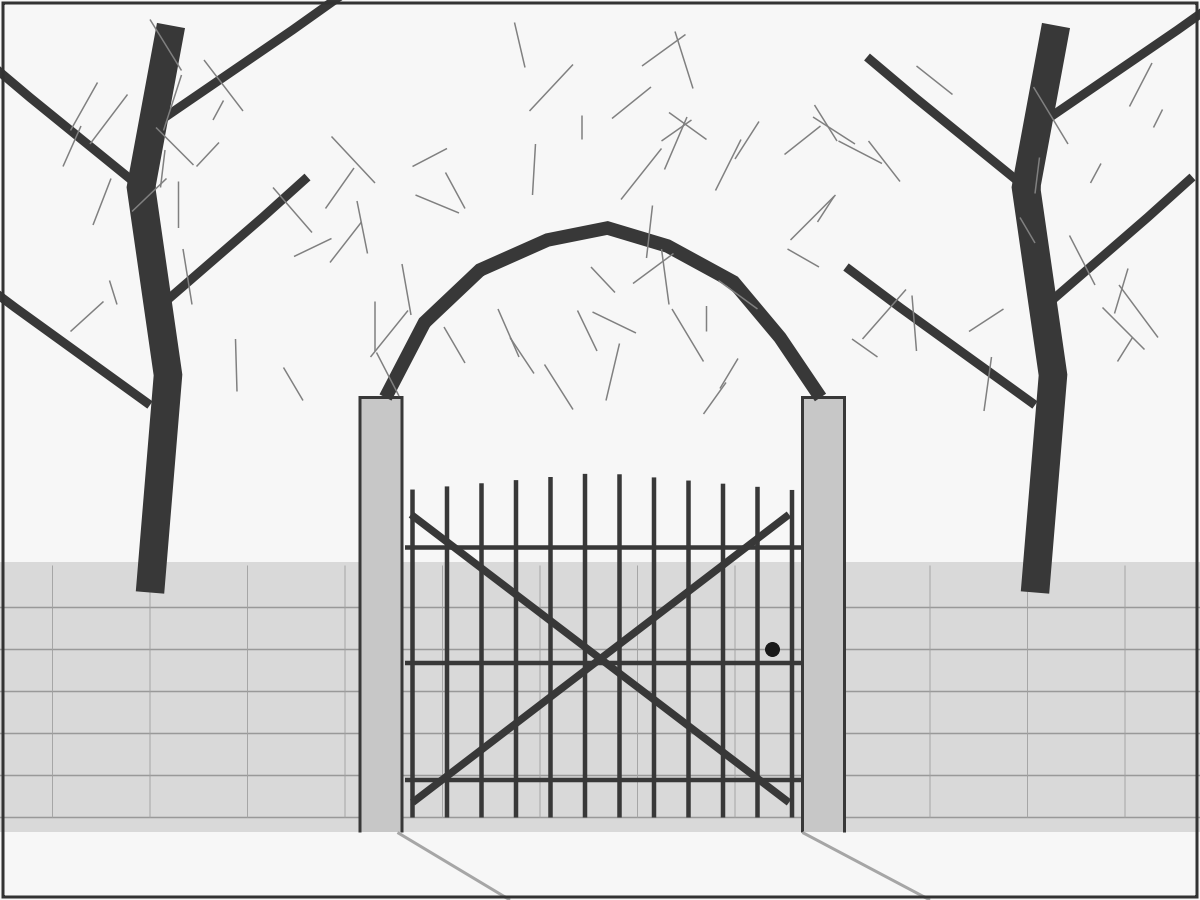
Mary Lennox has discovered the door to a garden that has been locked for ten years. This extract describes her first visit.
1It was the sweetest, most mysterious-looking place anyone could imagine. The
2high walls which shut it in were covered with the leafless stems of climbing
3roses which were so thick that they were matted together. Mary Lennox knew they
4were roses because she had seen a great many roses in India. All the ground was
5covered with grass of a wintry brown and out of it grew clumps of bushes which
6were surely rosebushes if they were alive. There were numbers of standard roses
7which had so spread their branches that they were like little trees. There were
8other trees in the garden, and one of the things which made the place look
9strangest and loveliest was that climbing roses had run all over them and swung
10down long tendrils which made light swaying curtains, and here and there they
11had caught at each other or at a far-reaching branch and had crept from one tree
12to another and made lovely bridges of themselves. There were neither leaves nor
13roses on them now and Mary did not know whether they were dead or alive, but
14their thin gray or brown branches and sprays looked like a sort of hazy mantle
15spreading over everything, walls, and trees, and even brown grass, where they
16had fallen from their fastenings and run along the ground. It was this hazy
17tangle from tree to tree which made it all look so mysterious. Mary had thought
18it must be different from other gardens which had not been left all by
19themselves so long; and indeed it was different from any other place she had
20ever seen in her life.
21“How still it is!” she whispered. “How still!”
22Then she waited a moment and listened at the stillness. The robin, who had flown
23to his treetop, was still as all the rest. He did not even flutter his wings; he
24sat without stirring, and looked at Mary.
25“No wonder it is still,” she whispered again. “I am the first person who has
26spoken in here for ten years.”
27She moved away from the door, stepping as softly as if she were afraid of
28awakening someone. She was glad that there was grass under her feet and that her
29steps made no sounds. She walked under one of the fairy-like gray arches between
30the trees and looked up at the sprays and tendrils which formed them.
31“I wonder if they are all quite dead,” she said. “Is it all a quite dead garden?
32I wish it wasn’t.”
33If she had been Ben Weatherstaff she could have told whether the wood was alive
34by looking at it, but she could only see that there were only gray or brown
35sprays and branches and none showed any signs of even a tiny leaf-bud anywhere.
36But she was inside the wonderful garden and she could come through the door
37under the ivy any time and she felt as if she had found a world all her own.
38The sun was shining inside the four walls and the high arch of blue sky over
39this particular piece of Misselthwaite seemed even more brilliant and soft than
40it was over the moor. The robin flew down from his treetop and hopped about or
41flew after her from one bush to another. He chirped a good deal and had a very
42busy air, as if he were showing her things. Everything was strange and silent
43and she seemed to be hundreds of miles away from anyone, but somehow she did not
44feel lonely at all. All that troubled her was her wish that she knew whether all
45the roses were dead, or if perhaps some of them had lived and might put out
46leaves and buds as the weather got warmer. She did not want it to be a quite
47dead garden. If it were a quite alive garden, how wonderful it would be, and
48what thousands of roses would grow on every side!
Question 01 [4 marks]
Read again the first part of the source, from lines 1 to 6.
Answer all parts of this question.
Choose one answer for each question.
Shade the circle inside the box beside your chosen answer.
Select no more than one answer for each question.
Cross out the whole box if you make a mistake.
To restore an answer you crossed out, draw a circle around that box.
01.1 What covers the high walls?
Leafless rose stems
Thick curtains
Green ivy
01.2 Where has Mary seen many roses before?
In London
In India
On the moor
01.3 What colour is the grass?
Bright green
Wintry brown
Pale yellow
01.4 What grows out of the grass?
Clumps of bushes
Tall reeds
Rows of vegetables
Question 02 [8 marks]
Look in detail at this extract, from lines 7 to 20 of the source:
which had so spread their branches that they were like little trees. There were
other trees in the garden, and one of the things which made the place look
strangest and loveliest was that climbing roses had run all over them and swung
down long tendrils which made light swaying curtains, and here and there they
had caught at each other or at a far-reaching branch and had crept from one tree
to another and made lovely bridges of themselves. There were neither leaves nor
roses on them now and Mary did not know whether they were dead or alive, but
their thin gray or brown branches and sprays looked like a sort of hazy mantle
spreading over everything, walls, and trees, and even brown grass, where they
had fallen from their fastenings and run along the ground. It was this hazy
tangle from tree to tree which made it all look so mysterious. Mary had thought
it must be different from other gardens which had not been left all by
themselves so long; and indeed it was different from any other place she had
ever seen in her life.
How does the writer use language here to present the overgrown garden?
You could include the writer’s choice of:
words and phrases
language features and techniques
sentence forms.
Question 03 [8 marks]
You now need to think about the structure of the source as a whole.
This extract comes from a novel.
How has the writer structured the text to create a sense of Mary becoming attached to the garden?
You could write about:
how this effect has developed by the end of the source
how the writer uses structure to create an effect
other structural choices, including changes in mood, tone or perspective.
Question 04 [20 marks]
For this question focus on the later part of the source, from line 27 to the end.
The garden seems neglected and uncertain, but Mary responds to it with a growing sense of hope and belonging.
To what extent do you agree and/or disagree with this statement?
In your response, you could:
consider your impressions of Mary and the garden
comment on the methods the writer uses to create these impressions
support your response with references to the text.
Question 05 [40 marks]
A magazine is inviting entries for a creative writing competition.
Choose one of the options below for your entry.
Either
Write a description of an entrance to a garden. You may use the picture for ideas.
or
Write the opening of a story about someone who discovers a place that has been forgotten.
Marking guidance
Question 1
Award one mark for each correct selection: 1: Leafless rose stems; 2: In India; 3: Wintry brown; 4: Clumps of bushes. No mark if more than one answer remains selected for an item.
All four answers are explicit in lines 1-6.
Question 2
The repeated movement of the roses across trees and branches gives the garden an extensive, entangled appearance. Verbs such as crept suggest quiet growth rather than deliberate human design.
The curtains, bridges and mantle comparisons transform neglected plants into architecture or clothing. Explore how concealment can seem beautiful and mysterious rather than simply untidy.
The absence of leaves and uncertainty over life or death qualify the earlier praise. Reward precise explanation of how sensory detail and uncertainty coexist. Apply AO2 bands by best fit; credit other supported readings.
Question 3
The opening offers a panoramic description before narrowing to Mary’s whispered speech and the still robin. This makes her entry into the place feel intimate.
The silence is prolonged through pauses, listening and careful movement. Questions about whether the plants are alive interrupt the pleasure and retain uncertainty.
The perspective then shifts towards possession: Mary can return and feels she has found a world of her own. The final paragraph opens upwards to sunlight and follows the active robin, expanding possibility.
The ending imagines future roses rather than proving they will grow. The movement from observed decay to imagined life creates attachment without removing the mystery. Reward structural explanation, not a list of language devices.
Question 4
A supported response may agree, disagree or qualify the statement. Judge how the writer makes Mary’s attachment convincing while showing her limited knowledge.
Soft movement and questions suggest both wonder and caution. The apparently dead branches can sustain a bleak interpretation, but her wish that the garden were alive shows care.
The private world, brighter sky and accompanying robin can suggest welcome and emotional connection. Her lack of loneliness matters even while she seems far from other people.
The conditional ending projects thousands of roses into the future. It supports hope, but its uncertainty prevents a claim that the garden is already flourishing. Apply the AO4 bands by best fit.
Question 5
Mark the chosen response independently of Section A. It need not retell the source or use its characters. Treat the two options as equally valid.
AO5 (24 marks): judge the effectiveness of communication for the chosen description or narrative opening; appropriateness and control of tone, viewpoint and vocabulary; development of selected details; and purposeful organisation. Do not require a complete plot for the narrative opening.
AO6 (16 marks): judge sentence control and variety, grammar, punctuation and spelling separately from AO5. Reward accuracy and deliberate variation, not a count of unusual words or techniques.
Use the original practice band summaries below as indicative guidance and moderate against the current official writing criteria. This guide has not been standardised by AQA.