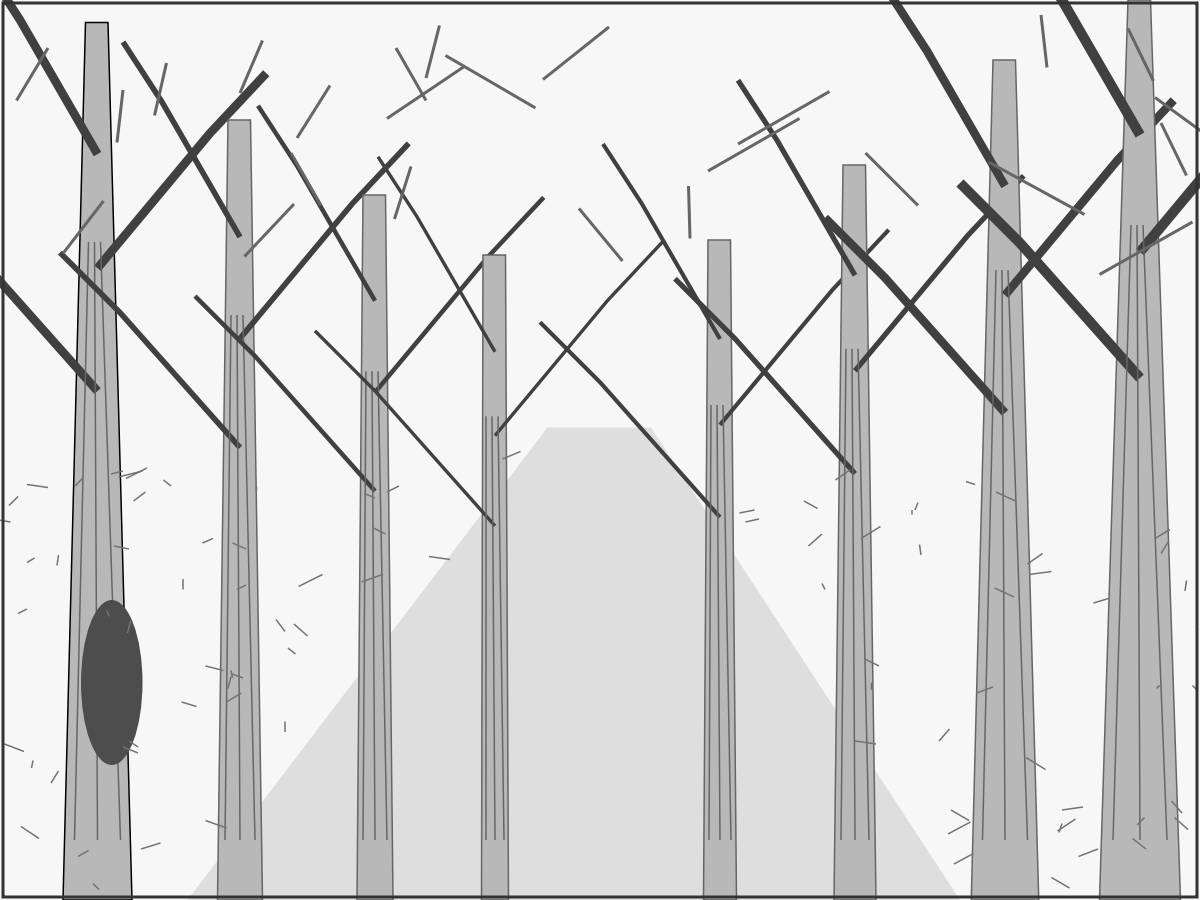
Mole has gone alone into the Wild Wood. The animals in this story think and behave like people.
1Then the faces began.
2It was over his shoulder, and indistinctly, that he first thought he saw a face,
3a little, evil, wedge-shaped face, looking out at him from a hole. When he
4turned and confronted it, the thing had vanished.
5He quickened his pace, telling himself cheerfully not to begin imagining things
6or there would be simply no end to it. He passed another hole, and another, and
7another; and then—yes!—no!—yes! certainly a little, narrow face, with hard eyes,
8had flashed up for an instant from a hole, and was gone. He hesitated—braced
9himself up for an effort and strode on. Then suddenly, and as if it had been so
10all the time, every hole, far and near, and there were hundreds of them, seemed
11to possess its face, coming and going rapidly, all fixing on him glances of
12malice and hatred: all hard-eyed and evil and sharp.
13If he could only get away from the holes in the banks, he thought, there would
14be no more faces. He swung off the path and plunged into the untrodden places of
15the wood.
16Then the whistling began.
17Very faint and shrill it was, and far behind him, when first he heard it; but
18somehow it made him hurry forward. Then, still very faint and shrill, it sounded
19far ahead of him, and made him hesitate and want to go back. As he halted in
20indecision it broke out on either side, and seemed to be caught up and passed on
21throughout the whole length of the wood to its farthest limit. They were up and
22alert and ready, evidently, whoever they were! And he—he was alone, and unarmed,
23and far from any help; and the night was closing in.
24Then the pattering began.
25He thought it was only falling leaves at first, so slight and delicate was the
26sound of it. Then as it grew it took a regular rhythm, and he knew it for
27nothing else but the pat-pat-pat of little feet still a very long way off. Was
28it in front or behind? It seemed to be first one, and then the other, then both.
29It grew and it multiplied, till from every quarter as he listened anxiously,
30leaning this way and that, it seemed to be closing in on him. As he stood still
31to hearken, a rabbit came running hard towards him through the trees. He waited,
32expecting it to slacken pace or to swerve from him into a different course.
33Instead, the animal almost brushed him as it dashed past, his face set and hard,
34his eyes staring. “Get out of this, you fool, get out!” the Mole heard him
35mutter as he swung round a stump and disappeared down a friendly burrow.
36The pattering increased till it sounded like sudden hail on the dry leaf-carpet
37spread around him. The whole wood seemed running now, running hard, hunting,
38chasing, closing in round something or—somebody? In panic, he began to run too,
39aimlessly, he knew not whither. He ran up against things, he fell over things
40and into things, he darted under things and dodged round things. At last he took
41refuge in the deep, dark hollow of an old beech tree, which offered shelter,
42concealment—perhaps even safety, but who could tell? Anyhow, he was too tired to
43run any further, and could only snuggle down into the dry leaves which had
44drifted into the hollow and hope he was safe for a time. And as he lay there
45panting and trembling, and listened to the whistlings and the patterings
46outside, he knew it at last, in all its fullness, that dread thing which other
47little dwellers in field and hedgerow had encountered here, and known as their
48darkest moment—that thing which the Rat had vainly tried to shield him from—the
49Terror of the Wild Wood!
Question 01 [4 marks]
Read again the first part of the source, from lines 1 to 6.
Answer all parts of this question.
Choose one answer for each question.
Shade the circle inside the box beside your chosen answer.
Select no more than one answer for each question.
Cross out the whole box if you make a mistake.
To restore an answer you crossed out, draw a circle around that box.
01.1 Where does the first face appear?
In a hole
Above a tree
Beside a river
01.2 What shape is the first face?
Round
Wedge-shaped
Square
01.3 What happens when he turns to confront it?
It comes closer
It laughs
It vanishes
01.4 What does he do to his pace?
He slows it
He quickens it
He stops completely
Question 02 [8 marks]
Look in detail at this extract, from lines 17 to 23 of the source:
Very faint and shrill it was, and far behind him, when first he heard it; but
somehow it made him hurry forward. Then, still very faint and shrill, it sounded
far ahead of him, and made him hesitate and want to go back. As he halted in
indecision it broke out on either side, and seemed to be caught up and passed on
throughout the whole length of the wood to its farthest limit. They were up and
alert and ready, evidently, whoever they were! And he—he was alone, and unarmed,
and far from any help; and the night was closing in.
How does the writer use language here to convey Mole’s growing fear?
You could include the writer’s choice of:
words and phrases
language features and techniques
sentence forms.
Question 03 [8 marks]
You now need to think about the structure of the source as a whole.
This extract comes from a novel.
How has the writer structured the text to create a sense of increasing danger?
You could write about:
how this effect has developed by the end of the source
how the writer uses structure to create an effect
other structural choices, including changes in mood, tone or perspective.
Question 04 [20 marks]
For this question focus on the later part of the source, from line 24 to the end.
Mole’s terror seems understandable, even though he cannot be certain what is pursuing him.
To what extent do you agree and/or disagree with this statement?
In your response, you could:
consider your impressions of Mole and the danger around him
comment on the methods the writer uses to create these impressions
support your response with references to the text.
Question 05 [40 marks]
A magazine is inviting entries for a creative writing competition.
Choose one of the options below for your entry.
Either
Write a description of a path through a wood. You may use the picture for ideas.
or
Write the opening of a story in which someone thinks they are being followed.
Marking guidance
Question 1
Award one mark for each correct selection: 1: In a hole; 2: Wedge-shaped; 3: It vanishes; 4: He quickens it. No mark if more than one answer remains selected for an item.
All four answers are explicit in lines 1-6.
Question 2
The directional movement from behind to ahead and then both sides denies Mole a reliable escape route. The description makes a faint sound feel widespread.
The exclamation about unnamed pursuers turns an uncertain noise into organised readiness. Explore the difference between what is heard and what Mole assumes.
The repeated he and the sequence alone, unarmed and far from help isolate him; closing night adds pressure. Reward analysis of language effects within these lines, not outside events.
Question 3
Repeated short announcements introduce faces, whistling and pattering in successive stages. Each new sensory threat adds to the previous one.
The viewpoint stays close to Mole’s uncertain perceptions: movement away from faces takes him off the path, worsening his position rather than resolving the problem.
The rabbit’s urgent appearance interrupts the gathering noises and seems to confirm danger. Pace accelerates as sounds become pursuit and Mole runs without direction.
The tree hollow slows the action but safety remains conditional. The final naming of the Terror retrospectively gathers the earlier impressions into a single feared experience. Explain progression and effects rather than treating structure as sentence length alone.
Question 4
There is no required position. A qualified answer can find the fear reasonable while questioning how far imagination turns uncertain sounds into definite pursuers.
The sound grows, multiplies and seems to surround him. The rabbit’s warning and visible distress lend external support to Mole’s alarm.
The forest appears to hunt; questions and indefinite things keep the pursuers unidentified. The frantic movement can make his vulnerability convincing without identifying an actual attacker.
Shelter offers only perhaps safety. His exhaustion and trembling sustain the fear, while the final naming partly validates his experience within the narrative. Evaluate the effects of methods with references from the specified range; apply AO4 bands by best fit.
Question 5
Mark the chosen response independently of Section A. It need not retell the source or use its characters. Treat the two options as equally valid.
AO5 (24 marks): judge the effectiveness of communication for the chosen description or narrative opening; appropriateness and control of tone, viewpoint and vocabulary; development of selected details; and purposeful organisation. Do not require a complete plot for the narrative opening.
AO6 (16 marks): judge sentence control and variety, grammar, punctuation and spelling separately from AO5. Reward accuracy and deliberate variation, not a count of unusual words or techniques.
Use the original practice band summaries below as indicative guidance and moderate against the current official writing criteria. This guide has not been standardised by AQA.