AN INSPECTOR CALLS
Inspector Goole
Goole replaces the host’s social authority with moral scrutiny. His uncertain identity does not remove the force of what the family learns.
Read the accessible text and study notes
Inspector Goole
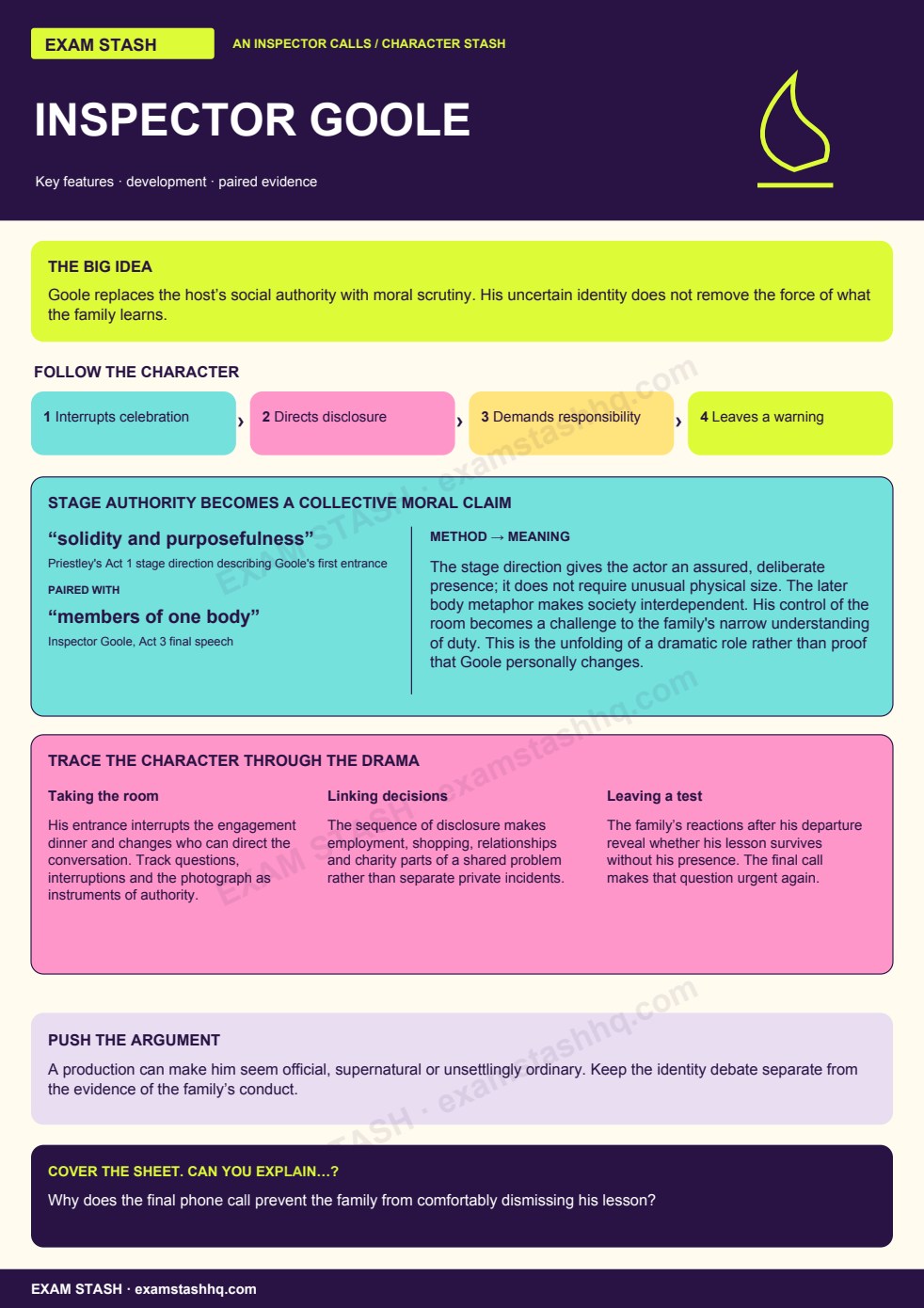
Goole replaces the host’s social authority with moral scrutiny. His uncertain identity does not remove the force of what the family learns.
Interrupts celebration → Directs disclosure → Demands responsibility → Leaves a warning
Stage authority becomes a collective moral claim
“solidity and purposefulness” — Priestley's Act 1 stage direction describing Goole's first entrance
paired with “members of one body” — Inspector Goole, Act 3 final speech
The stage direction gives the actor an assured, deliberate presence; it does not require unusual physical size. The later body metaphor makes society interdependent. His control of the room becomes a challenge to the family's narrow understanding of duty. This is the unfolding of a dramatic role rather than proof that Goole personally changes.
Push the argument
A production can make him seem official, supernatural or unsettlingly ordinary. Keep the identity debate separate from the evidence of the family’s conduct.
Recall
Why does the final phone call prevent the family from comfortably dismissing his lesson?
Trace the drama
Taking the room
His entrance interrupts the engagement dinner and changes who can direct the conversation. Track questions, interruptions and the photograph as instruments of authority.
Linking decisions
The sequence of disclosure makes employment, shopping, relationships and charity parts of a shared problem rather than separate private incidents.
Leaving a test
The family’s reactions after his departure reveal whether his lesson survives without his presence. The final call makes that question urgent again.
Evidence sources
- School quotation-recall sheet reproducing opening character stage directions. Its typography is simplified; quoted fragments selected avoid uncertain punctuation.
- Official WJEC Drama guide reproduces Inspector's final speech; short selected fragment verified against script. Do not copy guide's surrounding transcription uncritically: it contains typos.
Explore the play. Scene locations are used because page numbers vary by edition.