COMPARISON
Remains / War Photographer
Memory and conflict — landscape comparison.
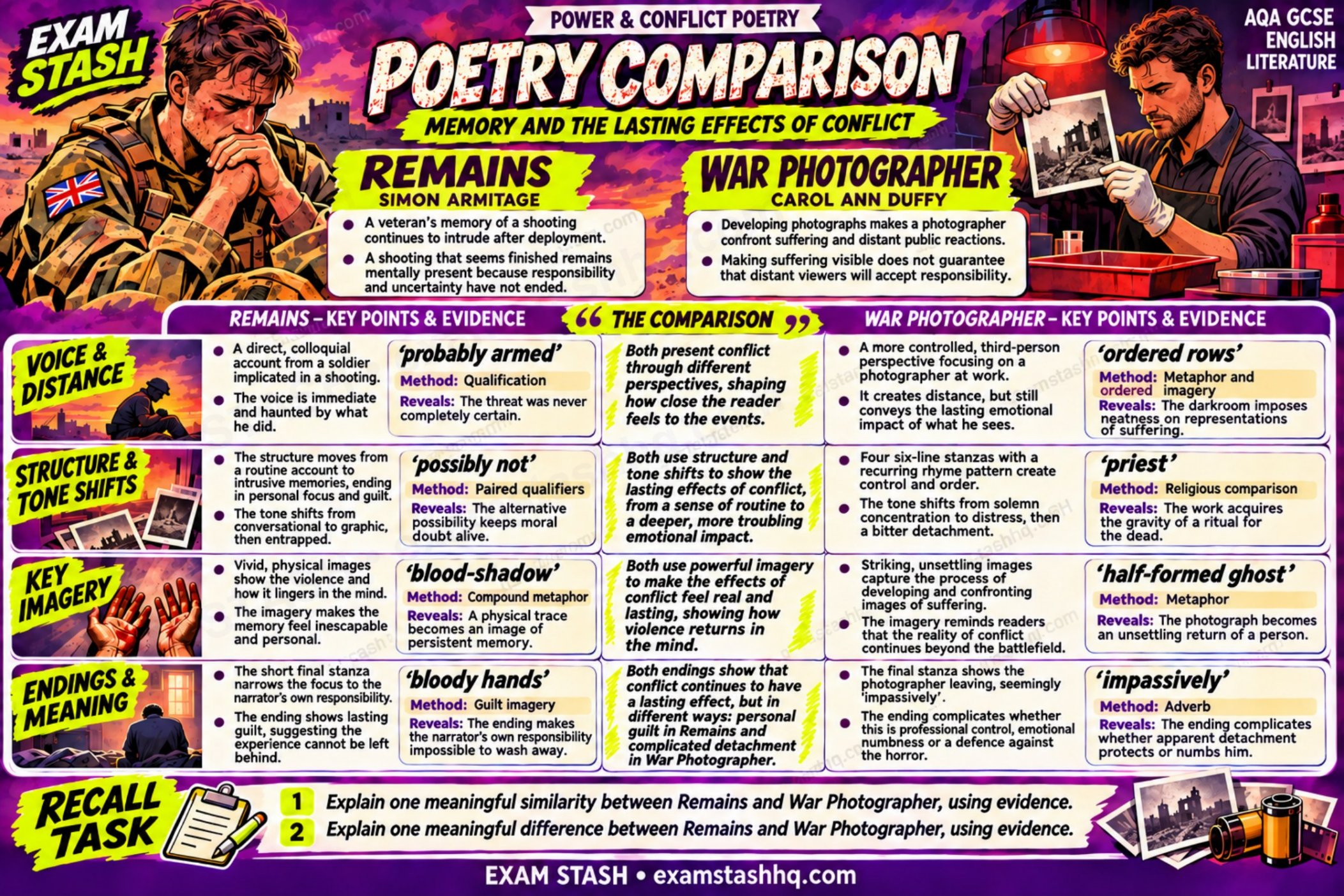
Read the comparison notes
Armitage presents a soldier whose account becomes a traumatic present. Duffy uses a controlled third-person perspective to show a photographer remembering suffering. Compare intrusive memories, guilt, the role of the witness and the distance between war and civilian life.
Remains
A dramatic monologue in colloquial free verse; a short final stanza concentrates the personal aftermath.
probably armed
Qualification: The threat was never completely certain.
possibly not
Counterweight: The alternative possibility keeps moral doubt alive.
blood-shadow
Compound metaphor: A physical trace becomes an image of persistent memory.
bloody hands
Guilt imagery: The ending makes the narrator’s own responsibility impossible to wash away.
Development and tone
Shooting — Conversational, then graphic: An apparently routine account becomes a vivid description of bodily destruction.
Return home — Intrusive and repetitive: The setting changes, but the killing returns through perception, sleep and dreams.
Final admission — Entrapped and guilty: The narrator’s focus narrows from the group to personal responsibility.
War Photographer
Four six-line stanzas with a recurring rhyme pattern; formal order contrasts with disturbing memories.
ordered rows
Visual arrangement: The darkroom imposes neatness on representations of suffering.
priest
Religious comparison: The work acquires the gravity of a ritual for the dead.
half-formed ghost
Metaphor: The photograph becomes an unsettling return of a person.
impassively
Adverb: The ending complicates whether apparent detachment protects or numbs him.
Development and tone
Darkroom — Solemn and controlled: Private processing resembles ritual, attempting to order what has been witnessed.
Emerging image — Distressed: A developing face draws the photographer back into an encounter with death.
Publication and departure — Bitterly detached: Editorial selection and brief public feeling limit the photograph’s power to change behaviour.