WORLDS AND LIVES
A Century Later
Violence cannot fully control the imagination or the collective demand for education.
Read the accessible text and study notes
What happens?
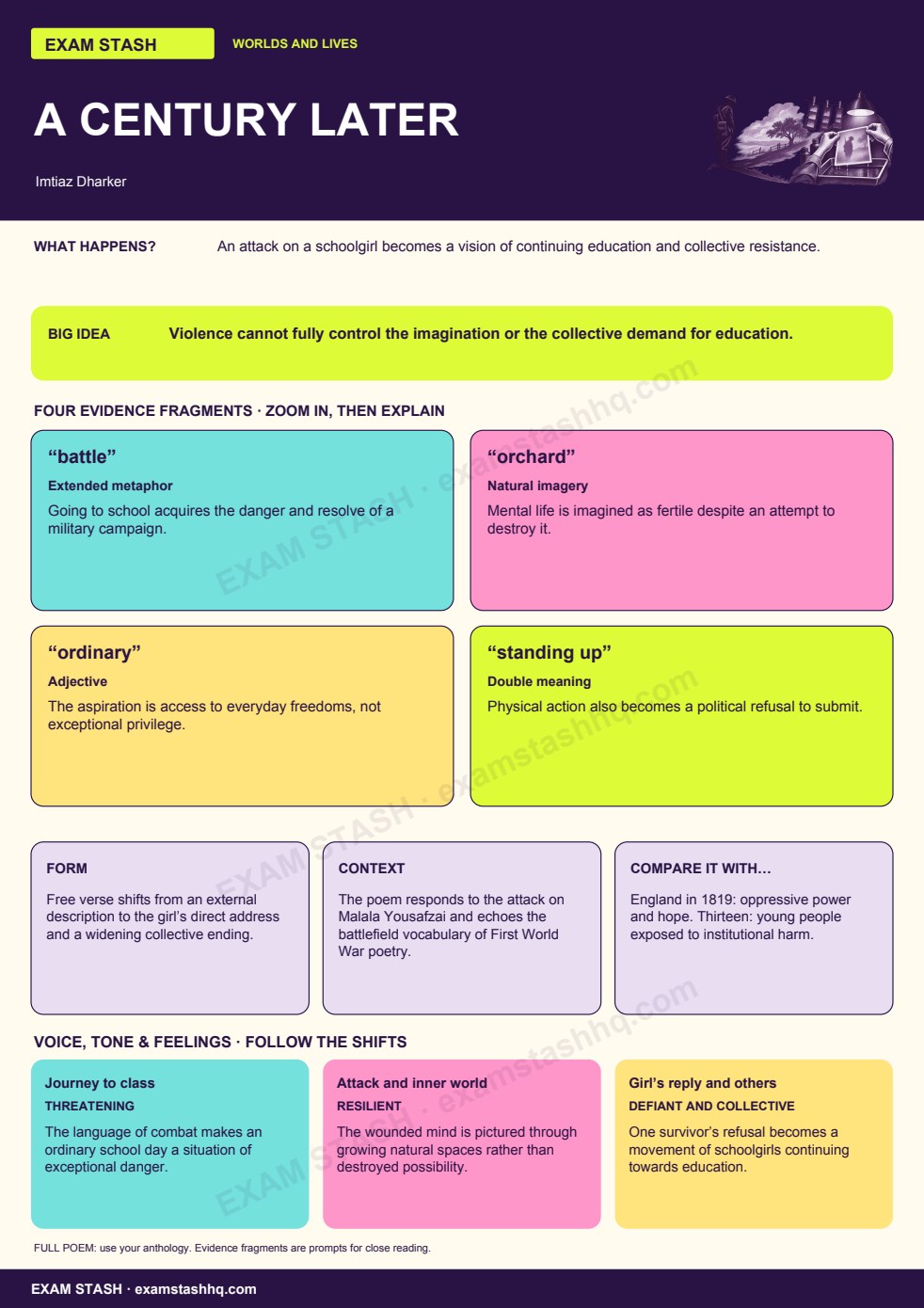
An attack on a schoolgirl becomes a vision of continuing education and collective resistance.
Big idea
Violence cannot fully control the imagination or the collective demand for education.
“battle”
Extended metaphor — Going to school acquires the danger and resolve of a military campaign.
“orchard”
Natural imagery — Mental life is imagined as fertile despite an attempt to destroy it.
“ordinary”
Adjective — The aspiration is access to everyday freedoms, not exceptional privilege.
“standing up”
Double meaning — Physical action also becomes a political refusal to submit.
Form
Free verse shifts from an external description to the girl’s direct address and a widening collective ending.
Context
The poem responds to the attack on Malala Yousafzai and echoes the battlefield vocabulary of First World War poetry.
Compare
England in 1819: oppressive power and hope. Thirteen: young people exposed to institutional harm.
Voice, tone and feelings
Journey to class · Threatening — The language of combat makes an ordinary school day a situation of exceptional danger.
Attack and inner world · Resilient — The wounded mind is pictured through growing natural spaces rather than destroyed possibility.
Girl’s reply and others · Defiant and collective — One survivor’s refusal becomes a movement of schoolgirls continuing towards education.
Recall
How does battle imagery change its meaning by the ending?
Read the full poem in your own AQA anthology. Anthology information and source.