WORLDS AND LIVES
England in 1819
Institutions that claim to sustain England are presented as draining its life, yet collapse may create an opening for change.
Read the accessible text and study notes
What happens?
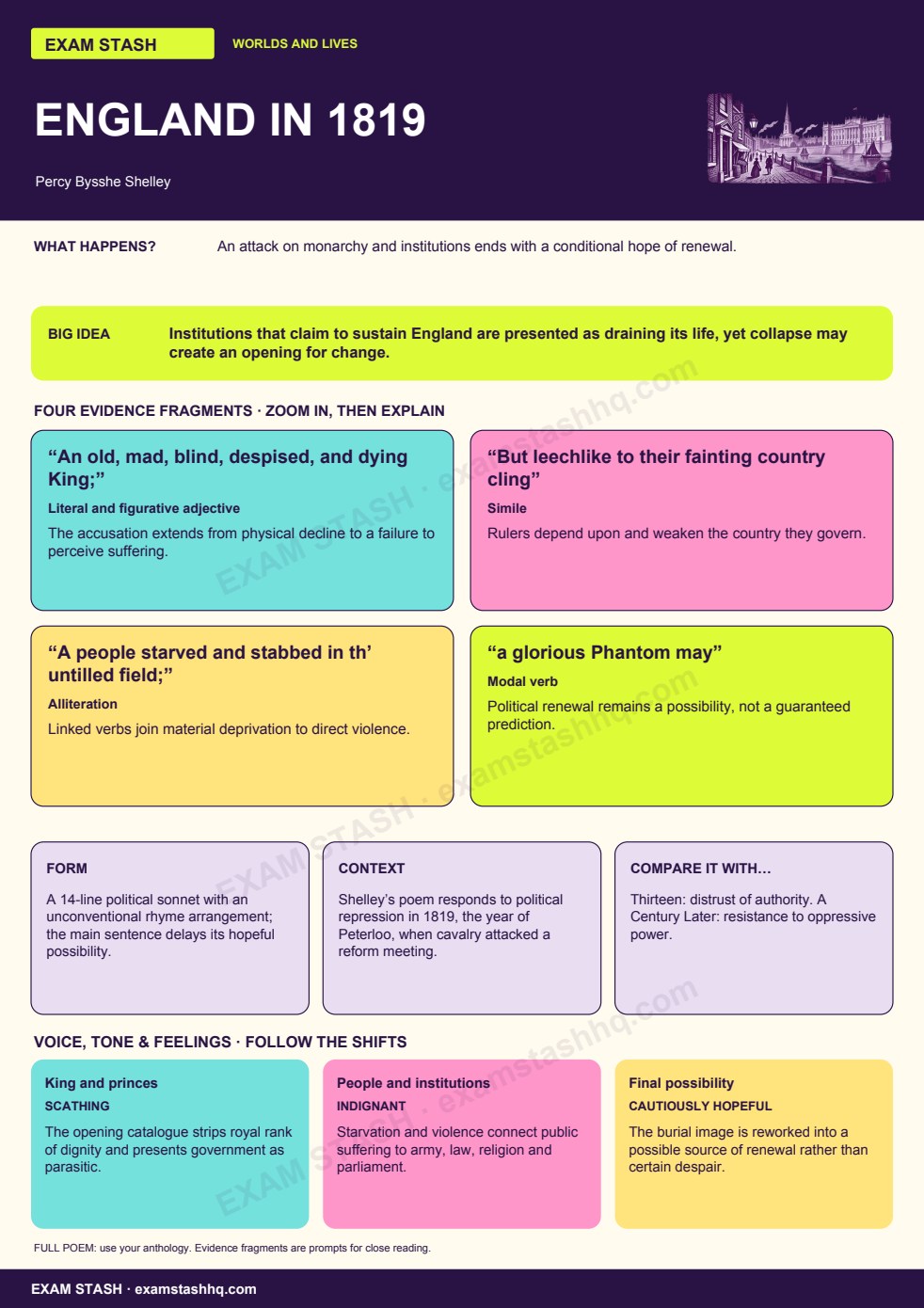
An attack on monarchy and institutions ends with a conditional hope of renewal.
Big idea
Institutions that claim to sustain England are presented as draining its life, yet collapse may create an opening for change.
“An old, mad, blind, despised, and dying King;”
Literal and figurative adjective — The accusation extends from physical decline to a failure to perceive suffering.
“But leechlike to their fainting country cling”
Simile — Rulers depend upon and weaken the country they govern.
“A people starved and stabbed in th’ untilled field;”
Alliteration — Linked verbs join material deprivation to direct violence.
“a glorious Phantom may”
Modal verb — Political renewal remains a possibility, not a guaranteed prediction.
Form
A 14-line political sonnet with an unconventional rhyme arrangement; the main sentence delays its hopeful possibility.
Context
Shelley’s poem responds to political repression in 1819, the year of Peterloo, when cavalry attacked a reform meeting.
Compare
Thirteen: distrust of authority. A Century Later: resistance to oppressive power.
Voice, tone and feelings
King and princes · Scathing — The opening catalogue strips royal rank of dignity and presents government as parasitic.
People and institutions · Indignant — Starvation and violence connect public suffering to army, law, religion and parliament.
Final possibility · Cautiously hopeful — The burial image is reworked into a possible source of renewal rather than certain despair.
Recall
How does the ending differ from the catalogue that precedes it?
Read the full poem in your own AQA anthology. Anthology information and source.