WORLDS AND LIVES
In a London Drawingroom
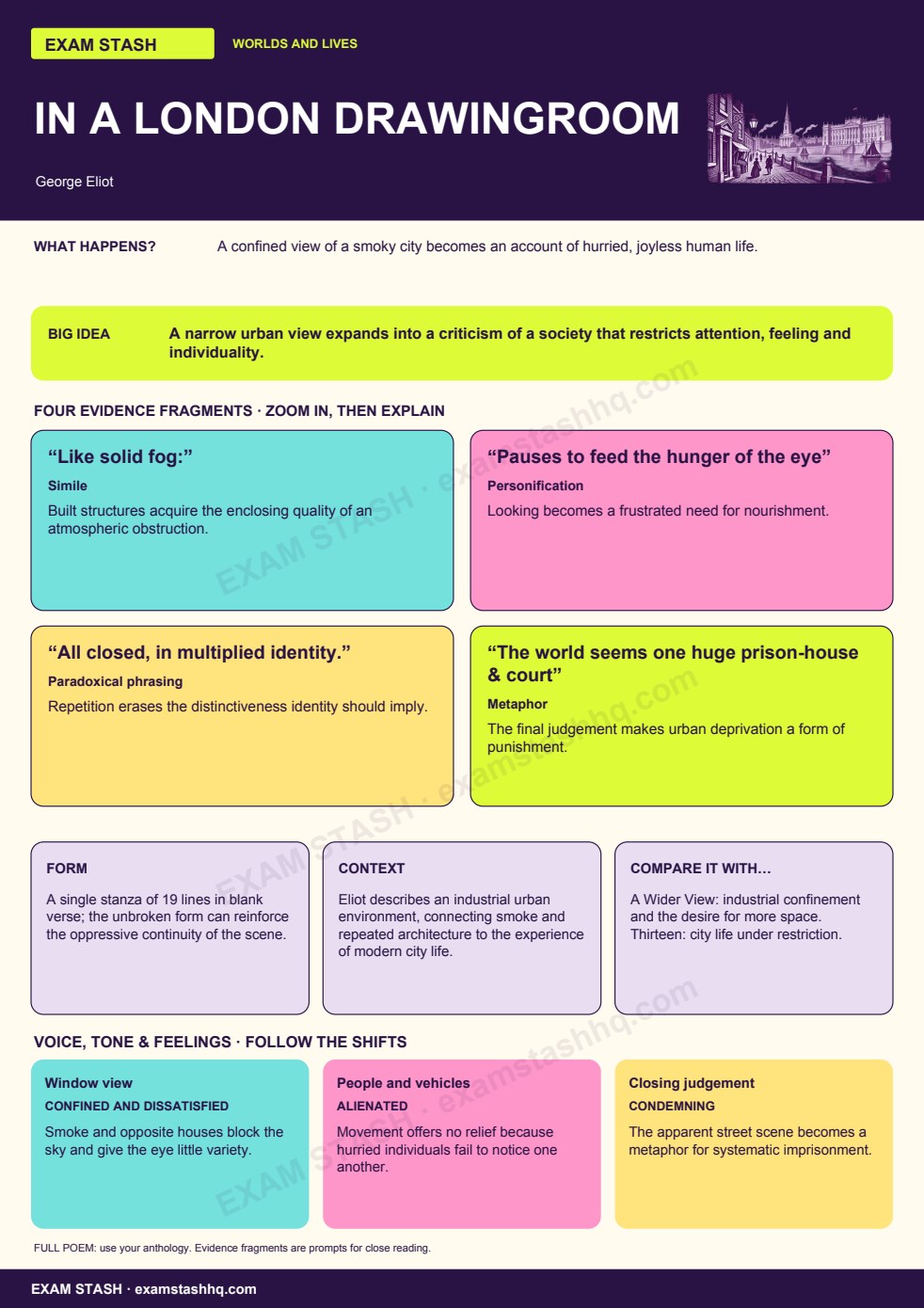
A narrow urban view expands into a criticism of a society that restricts attention, feeling and individuality.
Read the accessible text and study notes
What happens?
A confined view of a smoky city becomes an account of hurried, joyless human life.
Big idea
A narrow urban view expands into a criticism of a society that restricts attention, feeling and individuality.
“Like solid fog:”
Simile — Built structures acquire the enclosing quality of an atmospheric obstruction.
“Pauses to feed the hunger of the eye”
Personification — Looking becomes a frustrated need for nourishment.
“All closed, in multiplied identity.”
Paradoxical phrasing — Repetition erases the distinctiveness identity should imply.
“The world seems one huge prison-house & court”
Metaphor — The final judgement makes urban deprivation a form of punishment.
Form
A single stanza of 19 lines in blank verse; the unbroken form can reinforce the oppressive continuity of the scene.
Context
Eliot describes an industrial urban environment, connecting smoke and repeated architecture to the experience of modern city life.
Compare
A Wider View: industrial confinement and the desire for more space. Thirteen: city life under restriction.
Voice, tone and feelings
Window view · Confined and dissatisfied — Smoke and opposite houses block the sky and give the eye little variety.
People and vehicles · Alienated — Movement offers no relief because hurried individuals fail to notice one another.
Closing judgement · Condemning — The apparent street scene becomes a metaphor for systematic imprisonment.
Recall
How does the final prison image grow from the opening view?
Read the full poem in your own AQA anthology. Anthology information and source.