POWER AND CONFLICT
Kamikaze
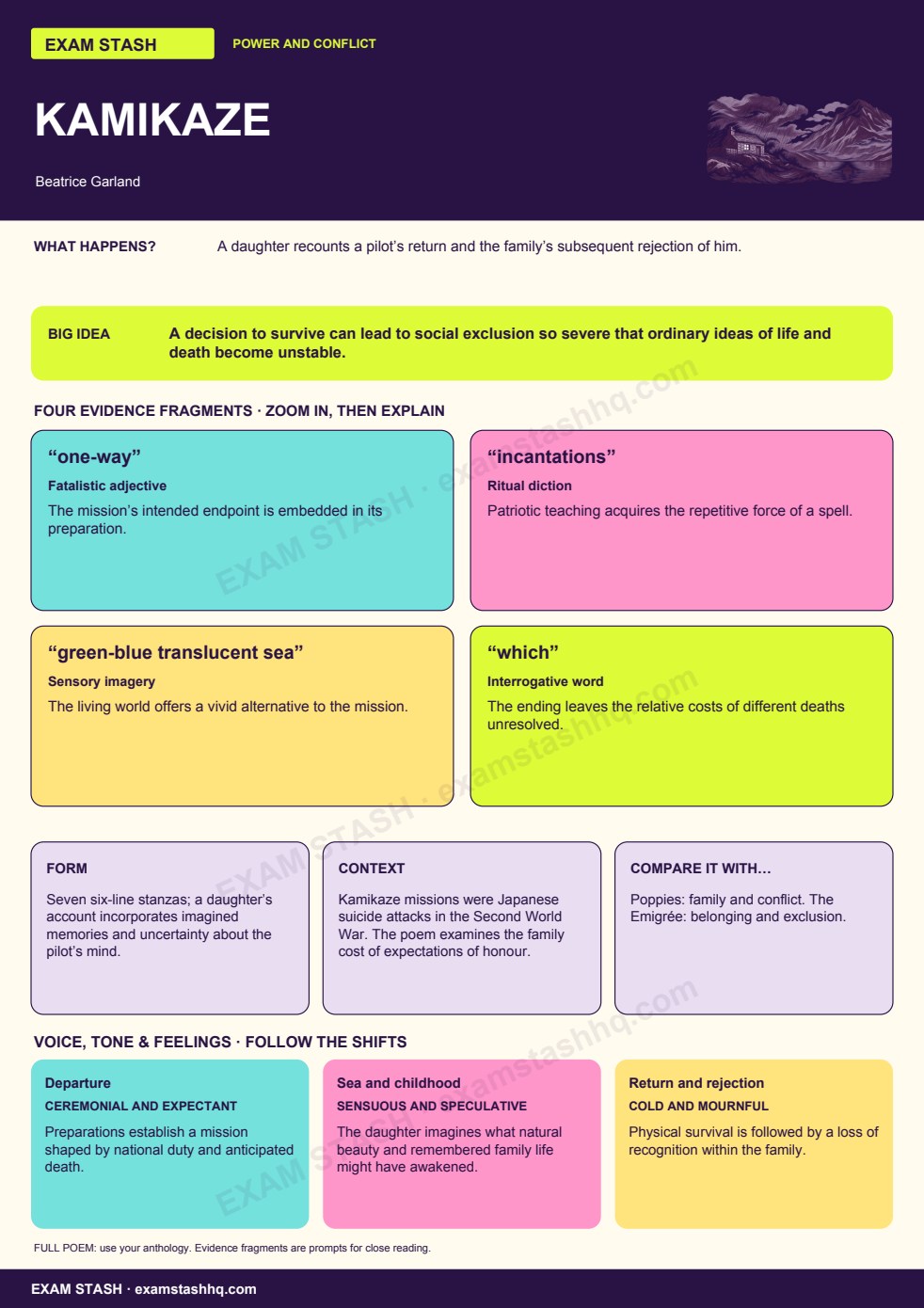
A decision to survive can lead to social exclusion so severe that ordinary ideas of life and death become unstable.
Read the accessible text and study notes
What happens?
A daughter recounts a pilot’s return and the family’s subsequent rejection of him.
Big idea
A decision to survive can lead to social exclusion so severe that ordinary ideas of life and death become unstable.
“one-way”
Fatalistic adjective — The mission’s intended endpoint is embedded in its preparation.
“incantations”
Ritual diction — Patriotic teaching acquires the repetitive force of a spell.
“green-blue translucent sea”
Sensory imagery — The living world offers a vivid alternative to the mission.
“which”
Interrogative word — The ending leaves the relative costs of different deaths unresolved.
Form
Seven six-line stanzas; a daughter’s account incorporates imagined memories and uncertainty about the pilot’s mind.
Context
Kamikaze missions were Japanese suicide attacks in the Second World War. The poem examines the family cost of expectations of honour.
Compare
Poppies: family and conflict. The Emigrée: belonging and exclusion.
Voice, tone and feelings
Departure · Ceremonial and expectant — Preparations establish a mission shaped by national duty and anticipated death.
Sea and childhood · Sensuous and speculative — The daughter imagines what natural beauty and remembered family life might have awakened.
Return and rejection · Cold and mournful — Physical survival is followed by a loss of recognition within the family.
Recall
How is surviving made to resemble a different kind of loss?
Read the full poem in your own AQA anthology. Anthology information and source.