WORLDS AND LIVES
Lines Written in Early Spring
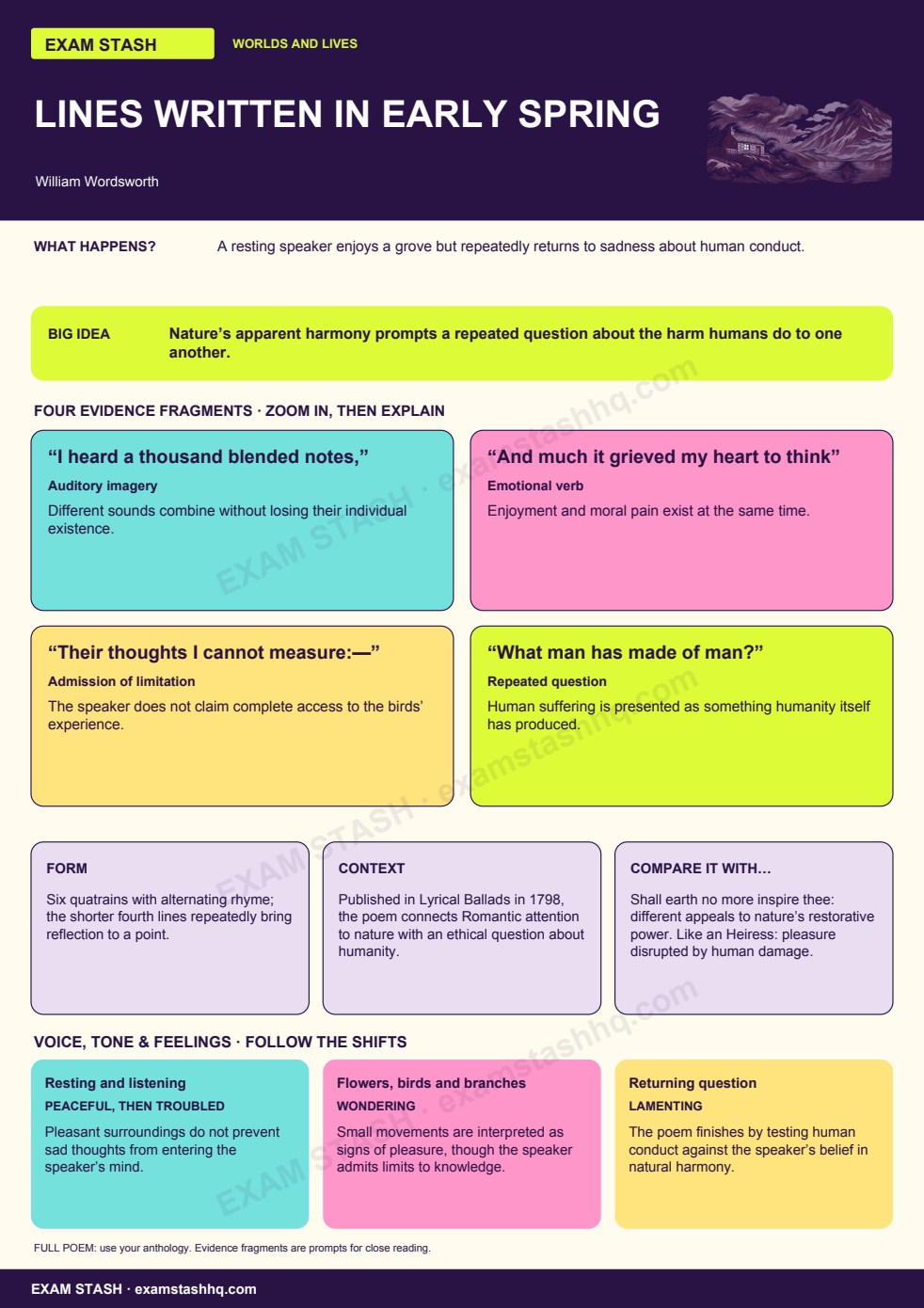
Nature’s apparent harmony prompts a repeated question about the harm humans do to one another.
Read the accessible text and study notes
What happens?
A resting speaker enjoys a grove but repeatedly returns to sadness about human conduct.
Big idea
Nature’s apparent harmony prompts a repeated question about the harm humans do to one another.
“I heard a thousand blended notes,”
Auditory imagery — Different sounds combine without losing their individual existence.
“And much it grieved my heart to think”
Emotional verb — Enjoyment and moral pain exist at the same time.
“Their thoughts I cannot measure:—”
Admission of limitation — The speaker does not claim complete access to the birds’ experience.
“What man has made of man?”
Repeated question — Human suffering is presented as something humanity itself has produced.
Form
Six quatrains with alternating rhyme; the shorter fourth lines repeatedly bring reflection to a point.
Context
Published in Lyrical Ballads in 1798, the poem connects Romantic attention to nature with an ethical question about humanity.
Compare
Shall earth no more inspire thee: different appeals to nature’s restorative power. Like an Heiress: pleasure disrupted by human damage.
Voice, tone and feelings
Resting and listening · Peaceful, then troubled — Pleasant surroundings do not prevent sad thoughts from entering the speaker’s mind.
Flowers, birds and branches · Wondering — Small movements are interpreted as signs of pleasure, though the speaker admits limits to knowledge.
Returning question · Lamenting — The poem finishes by testing human conduct against the speaker’s belief in natural harmony.
Recall
Why does the question about humanity return?
Read the full poem in your own AQA anthology. Anthology information and source.