POWER AND CONFLICT
My Last Duchess
The Duke’s attempt to control a woman’s image exposes his own possessiveness.
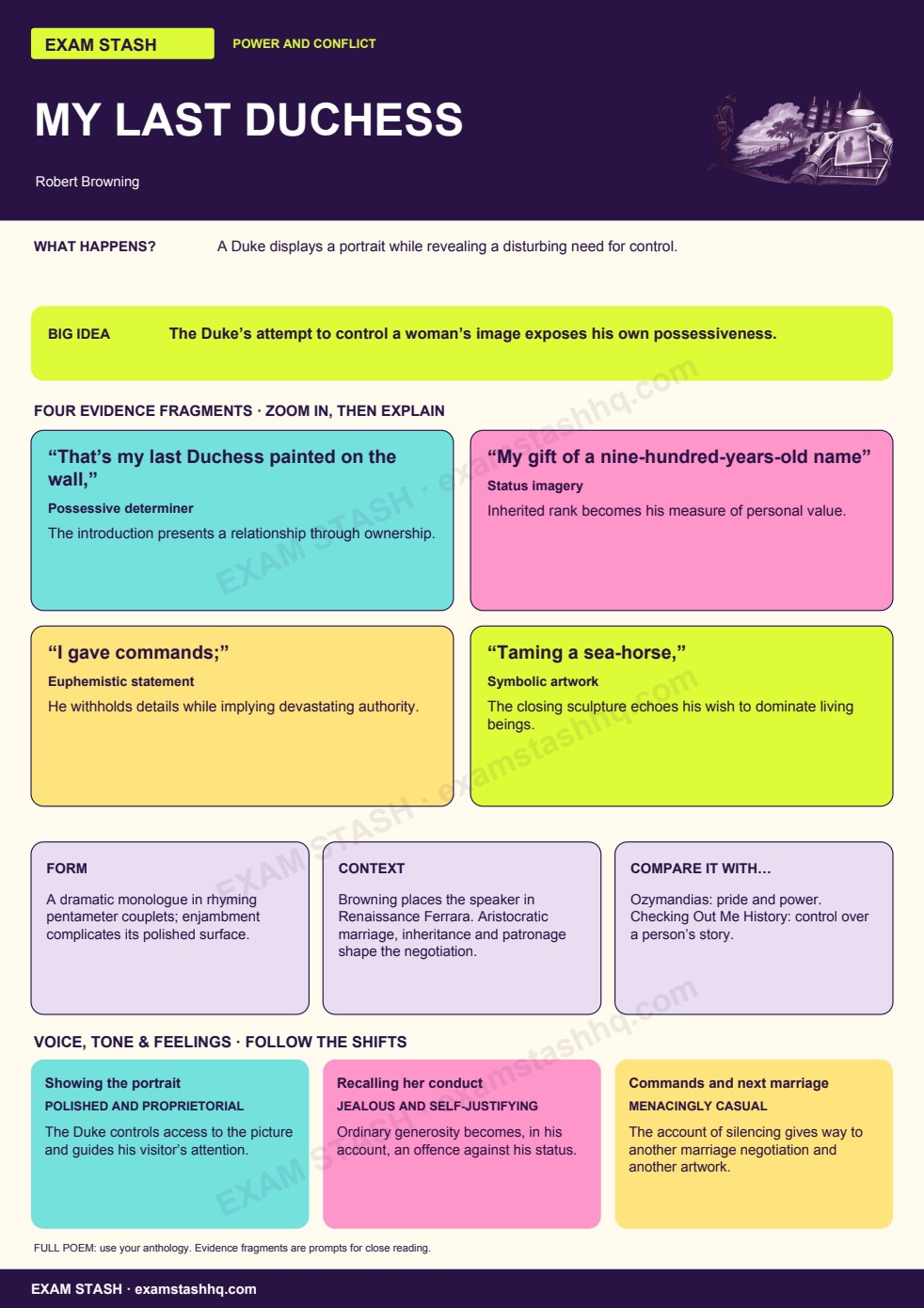
Read the accessible text and study notes
What happens?
A Duke displays a portrait while revealing a disturbing need for control.
Big idea
The Duke’s attempt to control a woman’s image exposes his own possessiveness.
“That’s my last Duchess painted on the wall,”
Possessive determiner — The introduction presents a relationship through ownership.
“My gift of a nine-hundred-years-old name”
Status imagery — Inherited rank becomes his measure of personal value.
“I gave commands;”
Euphemistic statement — He withholds details while implying devastating authority.
“Taming a sea-horse,”
Symbolic artwork — The closing sculpture echoes his wish to dominate living beings.
Form
A dramatic monologue in rhyming pentameter couplets; enjambment complicates its polished surface.
Context
Browning places the speaker in Renaissance Ferrara. Aristocratic marriage, inheritance and patronage shape the negotiation.
Compare
Ozymandias: pride and power. Checking Out Me History: control over a person’s story.
Voice, tone and feelings
Showing the portrait · Polished and proprietorial — The Duke controls access to the picture and guides his visitor’s attention.
Recalling her conduct · Jealous and self-justifying — Ordinary generosity becomes, in his account, an offence against his status.
Commands and next marriage · Menacingly casual — The account of silencing gives way to another marriage negotiation and another artwork.
Recall
What does the Duke reveal that he may not intend to reveal?
Read the full poem in your own AQA anthology. Anthology information and source.