WORLDS AND LIVES
pot
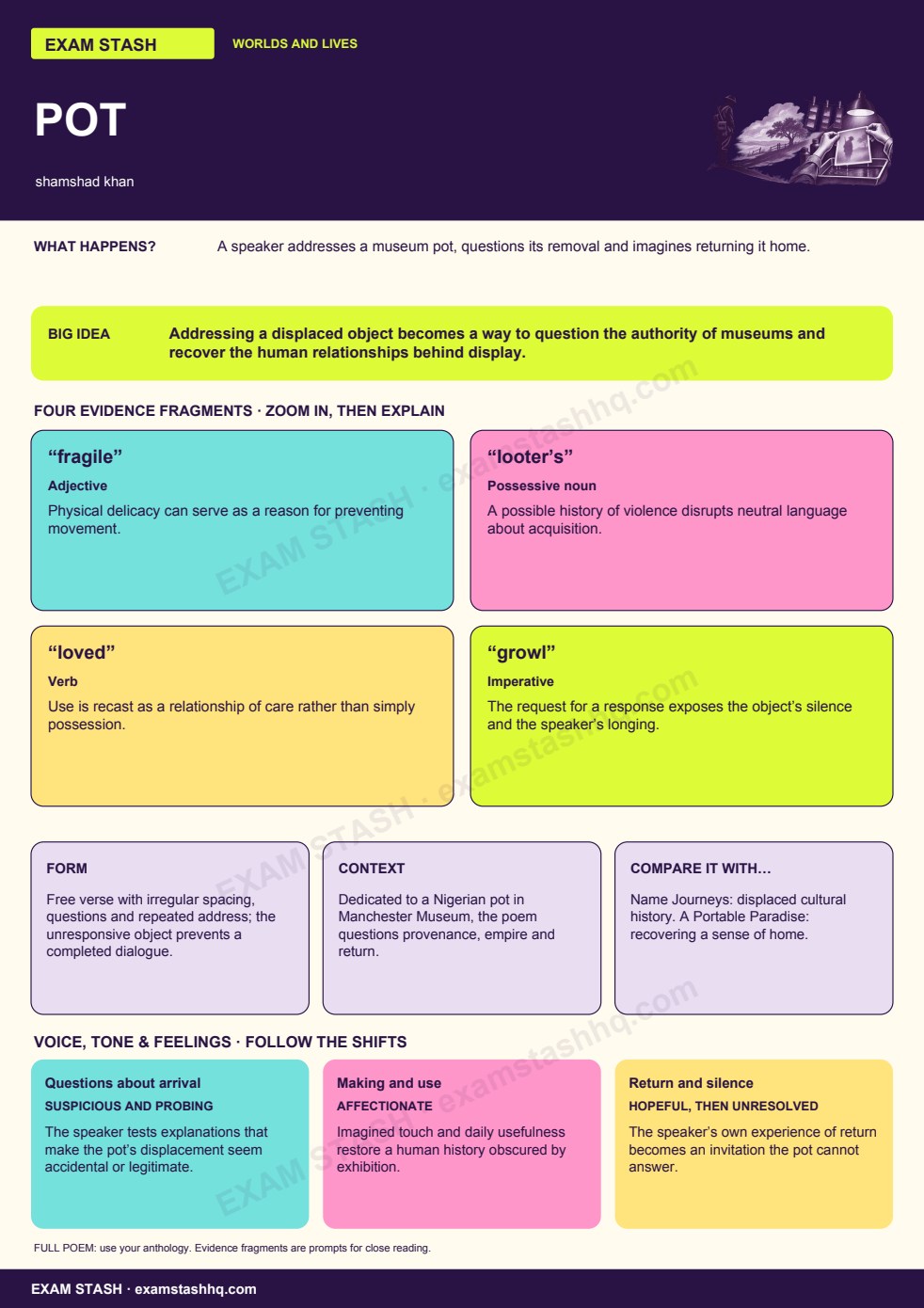
Addressing a displaced object becomes a way to question the authority of museums and recover the human relationships behind display.
Read the accessible text and study notes
What happens?
A speaker addresses a museum pot, questions its removal and imagines returning it home.
Big idea
Addressing a displaced object becomes a way to question the authority of museums and recover the human relationships behind display.
“fragile”
Adjective — Physical delicacy can serve as a reason for preventing movement.
“looter’s”
Possessive noun — A possible history of violence disrupts neutral language about acquisition.
“loved”
Verb — Use is recast as a relationship of care rather than simply possession.
“growl”
Imperative — The request for a response exposes the object’s silence and the speaker’s longing.
Form
Free verse with irregular spacing, questions and repeated address; the unresponsive object prevents a completed dialogue.
Context
Dedicated to a Nigerian pot in Manchester Museum, the poem questions provenance, empire and return.
Compare
Name Journeys: displaced cultural history. A Portable Paradise: recovering a sense of home.
Voice, tone and feelings
Questions about arrival · Suspicious and probing — The speaker tests explanations that make the pot’s displacement seem accidental or legitimate.
Making and use · Affectionate — Imagined touch and daily usefulness restore a human history obscured by exhibition.
Return and silence · Hopeful, then unresolved — The speaker’s own experience of return becomes an invitation the pot cannot answer.
Recall
What does the pot’s silence prevent the speaker from resolving?
Read the full poem in your own AQA anthology. Anthology information and source.