
GCSE English Literature
Thirteen
Overview
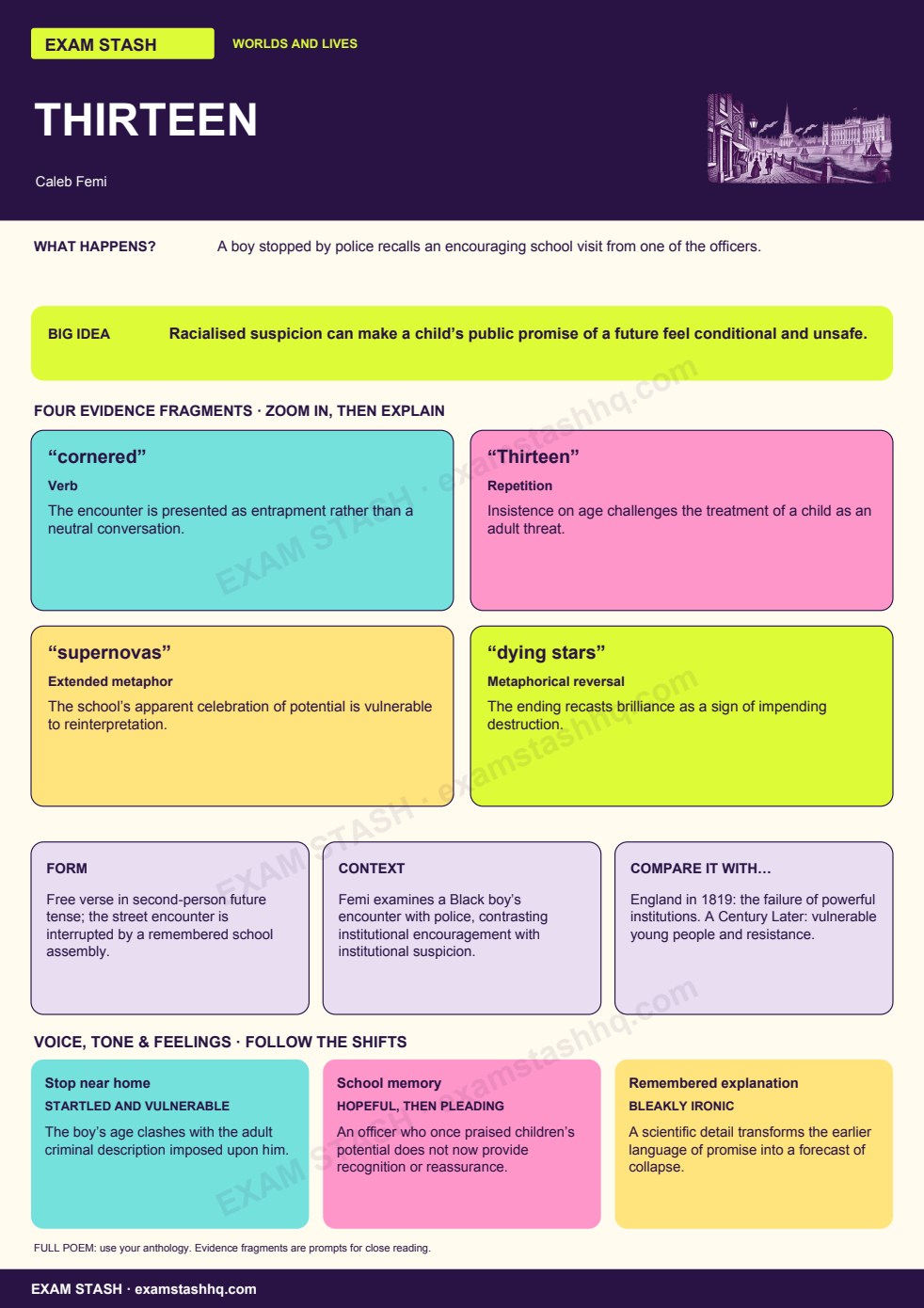
A boy stopped by police recalls an encouraging school visit from one of the officers.
Racialised suspicion can make a child’s public promise of a future feel conditional and unsafe.
Form and structure
Free verse uses second-person future tense to make an encounter feel anticipated and close. A school memory interrupts the street scene; repeated age and transformed stellar imagery expose the gap between promise and suspicion.
Stop near home · Startled and vulnerable
The boy’s age clashes with the adult criminal description imposed upon him.
School memory · Hopeful, then pleading
An officer who once praised children’s potential does not now provide recognition or reassurance.
Remembered explanation · Bleakly ironic
A scientific detail transforms the earlier language of promise into a forecast of collapse.
Text reference: cornered
Verb: The encounter is presented as entrapment rather than a neutral conversation.
Text reference: Thirteen
Repetition: Insistence on age challenges the treatment of a child as an adult threat.
Text reference: supernovas
Extended metaphor: The school’s apparent celebration of potential is vulnerable to reinterpretation.
Text reference: dying stars
Metaphorical reversal: The ending recasts brilliance as a sign of impending destruction.
Context
Femi examines a Black boy’s encounter with police, contrasting institutional encouragement with institutional suspicion.
Connections
England in 1819: the failure of powerful institutions. A Century Later: vulnerable young people and resistance.
Themes
Racial injustice
Childhood
Institutional power
Hope
Check your understanding
What is the effect of presenting the encounter through second-person future tense?
How does the school assembly change our understanding of the street encounter?
Why does the final image force us to reconsider the earlier praise?
How does the final account of stars change the school’s earlier message?
Sources and text credits
Caleb Femi · Thirteen Original analysis by Exam Stash.