
GCSE English Literature
With Birds You’re Never Lonely
Overview
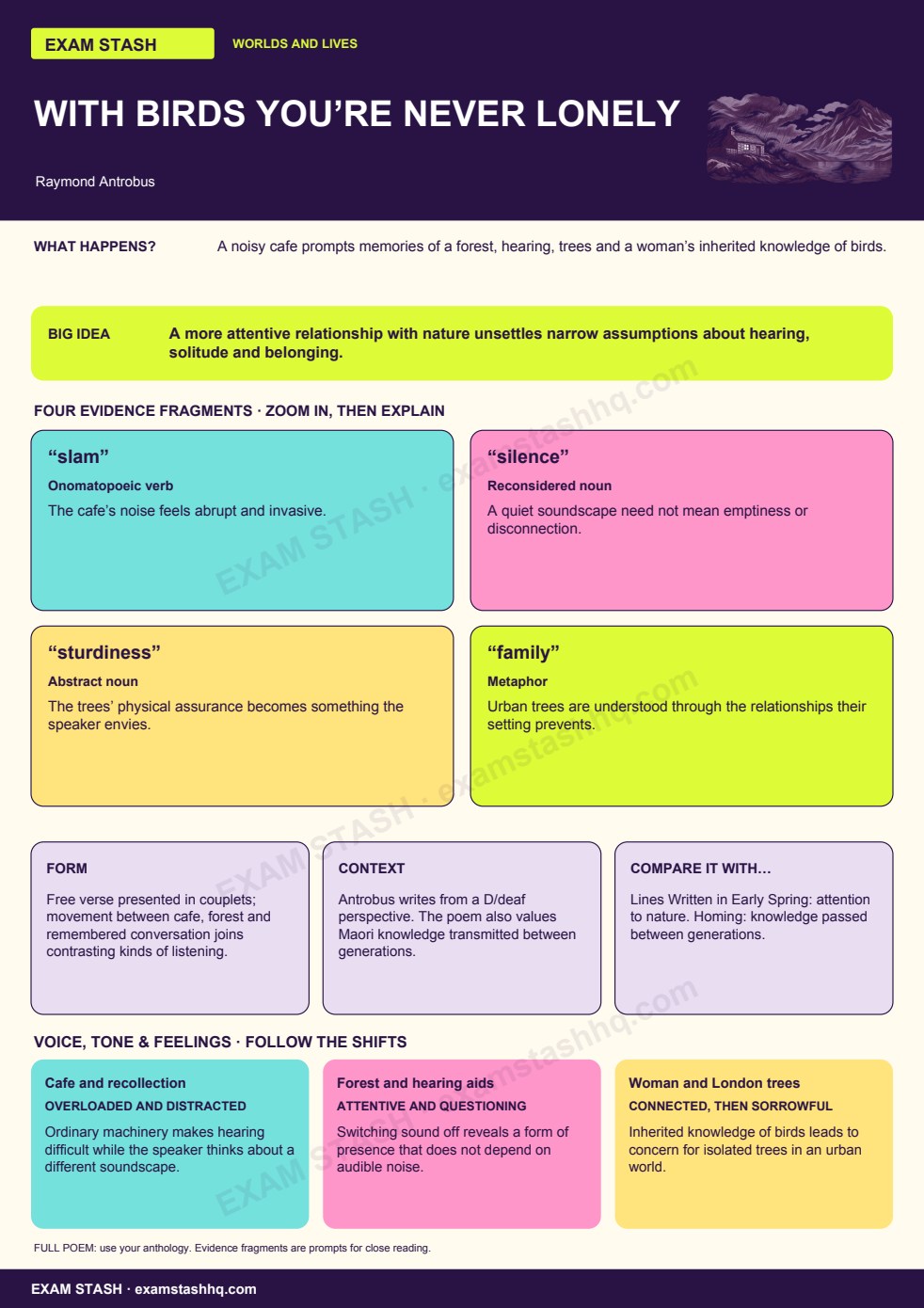
A noisy cafe prompts memories of a forest, hearing, trees and a woman’s inherited knowledge of birds.
A more attentive relationship with nature unsettles narrow assumptions about hearing, solitude and belonging.
Form and structure
Free verse in couplets followed by a single final line. The café frame opens into a forest memory and remembered conversation; changing hearing-aid settings alters perception rather than simply removing connection.
Cafe and recollection · Overloaded and distracted
Ordinary machinery makes hearing difficult while the speaker thinks about a different soundscape.
Forest and hearing aids · Attentive and questioning
Switching sound off reveals a form of presence that does not depend on audible noise.
Woman and London trees · Connected, then sorrowful
Inherited knowledge of birds leads to concern for isolated trees in an urban world.
Text reference: slam
Onomatopoeic verb: The cafe’s noise feels abrupt and invasive.
Text reference: silence
Reconsidered noun: A quiet soundscape need not mean emptiness or disconnection.
Text reference: sturdiness
Abstract noun: The trees’ physical assurance becomes something the speaker envies.
Text reference: family
Metaphor: Urban trees are understood through the relationships their setting prevents.
Context
Antrobus is a Deaf British-Jamaican poet. The poem makes hearing-aid use part of an active, changing relationship with sound. A Māori woman’s inherited knowledge challenges a narrow urban understanding of nature; do not generalise her account into a claim about all Māori people.
Connections
Lines Written in Early Spring: attention to nature. Homing: knowledge passed between generations.
Themes
Nature
Sensory experience
Belonging
Inherited knowledge
Check your understanding
Why is silence in the forest presented as presence rather than emptiness?
What changes when the speaker imagines trees writing about humans?
How does the isolated final line complicate the preceding couplets?
Why is the forest’s silence different from loneliness?
Sources and text credits
Raymond Antrobus · With Birds You’re Never Lonely Original analysis by Exam Stash.